
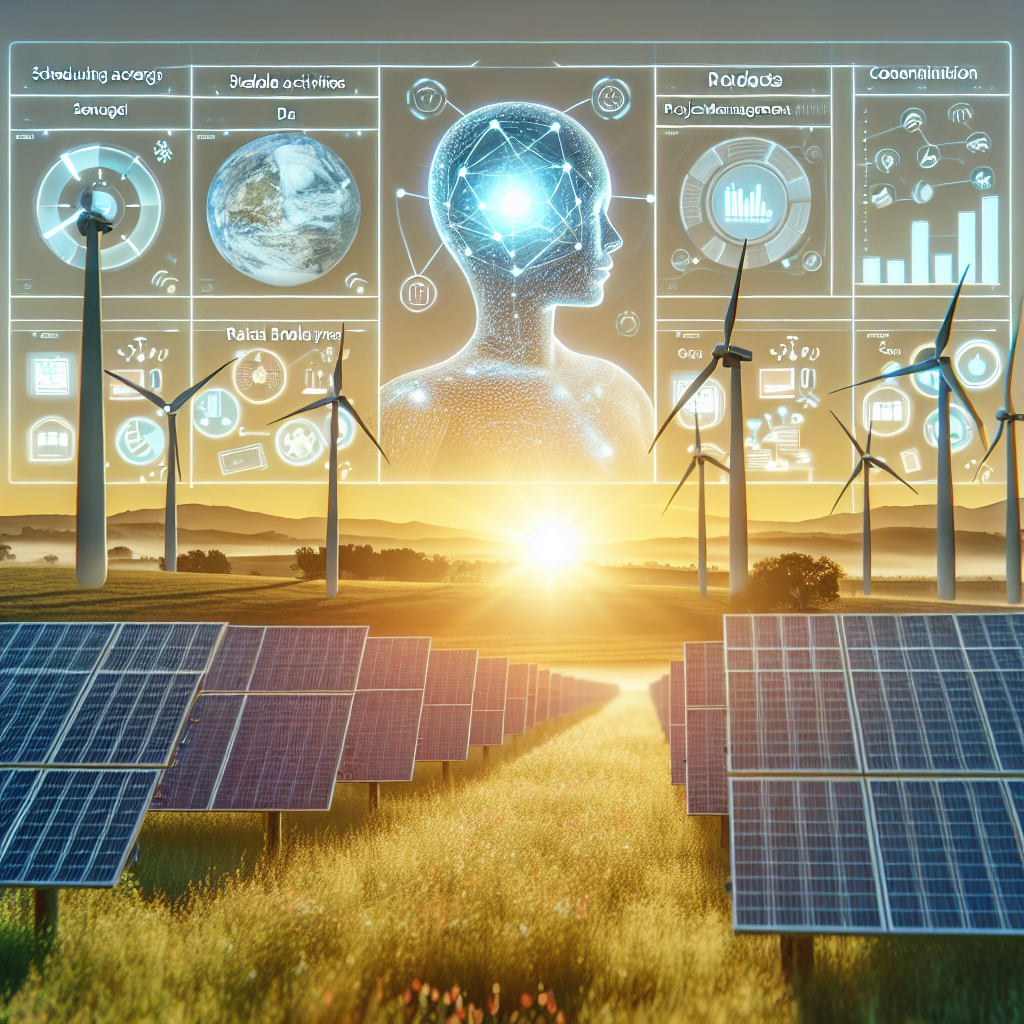
Renewable energy has become an increasingly important part of the global energy mix as countries strive to reduce their carbon emissions and combat climate change. With the rise in renewable energy projects, there is a growing need for effective project management to ensure the success of these initiatives. Artificial intelligence (AI) has the potential to revolutionize renewable energy project management by streamlining processes, improving efficiency, and optimizing decision-making. In this article, we will explore how AI can be used to enhance renewable energy project management and address some frequently asked questions on the topic.
1. What is AI?
AI refers to the simulation of human intelligence in machines that are programmed to think and act like humans. This includes tasks such as learning, reasoning, problem-solving, perception, and language understanding. AI technologies, such as machine learning and deep learning, have the ability to analyze vast amounts of data and make predictions or decisions based on that data.
2. How can AI improve renewable energy project management?
AI can be applied to various aspects of renewable energy project management to enhance efficiency and effectiveness. Some of the key ways in which AI can improve project management include:
– Data analysis and forecasting: AI algorithms can analyze large datasets to identify patterns and trends that can help project managers make informed decisions. For example, AI can predict energy production levels based on weather forecasts and historical data, allowing project managers to optimize energy generation and distribution.
– Risk management: AI can be used to assess and mitigate risks associated with renewable energy projects. By analyzing data on factors such as weather conditions, equipment performance, and market trends, AI can help project managers identify potential risks and develop strategies to minimize their impact.
– Asset management: AI technologies, such as predictive maintenance algorithms, can help project managers optimize the performance of renewable energy assets. By analyzing data on equipment health and performance, AI can predict when maintenance is needed and prevent costly downtime.
– Resource optimization: AI can optimize the use of resources, such as land and labor, in renewable energy projects. By analyzing data on project requirements and constraints, AI can help project managers allocate resources more effectively and reduce waste.
– Decision support: AI can provide decision support to project managers by analyzing data and recommending actions based on that analysis. For example, AI can suggest optimal maintenance schedules or energy trading strategies to maximize project profitability.
3. Case studies of AI applications in renewable energy project management
There are already several examples of AI being used to improve renewable energy project management. For instance, Envision Energy, a Chinese renewable energy company, has developed an AI-powered platform called EnOSTM that uses machine learning algorithms to optimize wind farm operations. By analyzing data on wind patterns, equipment performance, and energy markets, EnOSTM can predict energy production levels and recommend actions to maximize efficiency.
Another example is Innowatts, a US-based energy analytics company that uses AI to optimize energy trading and distribution. By analyzing data on energy consumption, market prices, and weather conditions, Innowatts can predict energy demand and supply levels and help utilities optimize their operations.
4. Challenges and limitations of using AI in renewable energy project management
While AI has the potential to revolutionize renewable energy project management, there are also challenges and limitations that need to be addressed. Some of the key challenges include:
– Data quality: AI algorithms rely on high-quality data to make accurate predictions and decisions. In the case of renewable energy projects, data on factors such as weather conditions, equipment performance, and energy markets may be incomplete or inaccurate, which can affect the reliability of AI analyses.
– Scalability: Implementing AI technologies in renewable energy project management requires significant investment in infrastructure and expertise. Small-scale projects or companies with limited resources may struggle to adopt AI effectively.
– Regulation and ethics: AI technologies raise concerns about privacy, security, and bias that need to be addressed through appropriate regulations and ethical guidelines. In the context of renewable energy project management, issues such as data privacy and algorithm transparency are particularly important.
– Human expertise: While AI can automate many tasks and improve efficiency, human expertise is still essential for decision-making and problem-solving in renewable energy projects. Project managers need to have a good understanding of AI technologies and their limitations to use them effectively.
5. Future trends in AI for renewable energy project management
Looking ahead, there are several trends in AI that are likely to shape the future of renewable energy project management. Some of the key trends to watch include:
– AI-powered virtual assistants: Virtual assistants powered by AI technologies, such as chatbots or voice-activated systems, can help project managers access information and make decisions more efficiently. These virtual assistants can provide real-time updates on project status, recommend actions, and answer queries.
– Edge computing: Edge computing technologies, which process data closer to the source of generation, can improve the performance of AI algorithms in renewable energy projects. By reducing latency and increasing data processing speed, edge computing can enhance the accuracy and reliability of AI analyses.
– Explainable AI: Explainable AI technologies, which provide transparency and interpretability in AI decision-making, are becoming increasingly important in renewable energy project management. By explaining how AI algorithms reach their conclusions, project managers can better understand and trust the recommendations provided.
– Collaborative AI: Collaborative AI technologies, which enable human-AI collaboration in decision-making, can enhance the effectiveness of renewable energy project management. By combining human expertise with AI capabilities, project managers can make more informed and timely decisions.
6. FAQs
Q: How can AI help in predicting energy production levels in renewable energy projects?
A: AI algorithms can analyze data on factors such as weather conditions, equipment performance, and historical energy production levels to predict future energy production levels. By identifying patterns and trends in the data, AI can provide accurate forecasts that help project managers optimize energy generation and distribution.
Q: What are some examples of AI applications in renewable energy project management?
A: Examples of AI applications in renewable energy project management include data analysis and forecasting, risk management, asset management, resource optimization, and decision support. Companies such as Envision Energy and Innowatts are using AI technologies to optimize wind farm operations and energy trading, respectively.
Q: What are the key challenges of using AI in renewable energy project management?
A: Some of the key challenges of using AI in renewable energy project management include data quality, scalability, regulation and ethics, and the need for human expertise. Addressing these challenges requires investment in data infrastructure, expertise in AI technologies, and adherence to ethical guidelines.
Q: What are some future trends in AI for renewable energy project management?
A: Future trends in AI for renewable energy project management include AI-powered virtual assistants, edge computing, explainable AI, and collaborative AI. These trends are likely to enhance the efficiency, accuracy, and transparency of AI applications in renewable energy projects.
In conclusion, AI has the potential to revolutionize renewable energy project management by improving efficiency, optimizing decision-making, and enhancing collaboration. While there are challenges and limitations to be addressed, the future looks promising for AI applications in renewable energy projects. By leveraging the power of AI technologies, project managers can unlock new opportunities for innovation and sustainability in the renewable energy sector.