
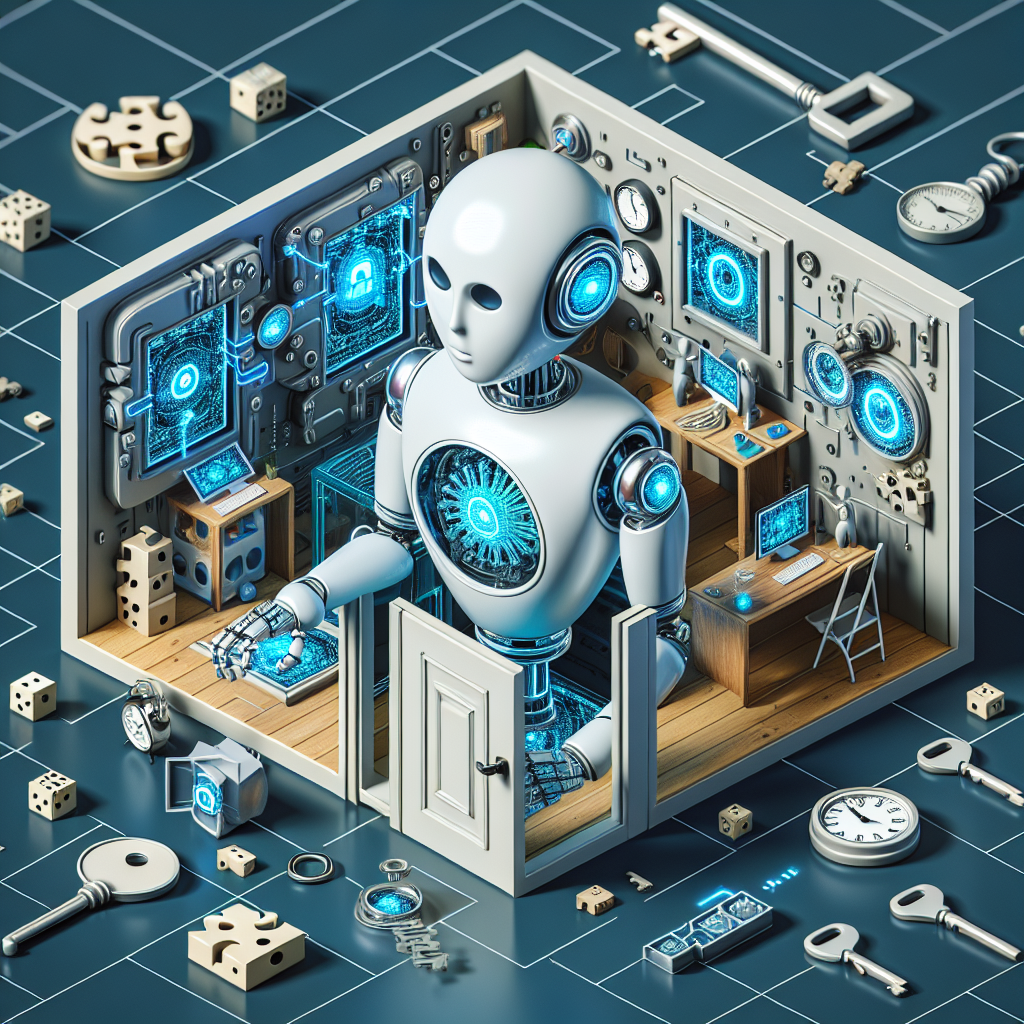
Escape rooms have become a popular form of entertainment in recent years, combining elements of puzzle solving, teamwork, and adventure to create a challenging and immersive experience for participants. These physical adventure games typically involve a group of players who are “locked” in a room and must solve a series of puzzles and riddles in order to escape within a set time limit.
In recent years, the incorporation of artificial intelligence (AI) technology into escape rooms has taken the experience to a whole new level. AI has the potential to enhance the challenges and immersiveness of escape rooms, making for a more engaging and dynamic experience for players. In this article, we will explore the role of AI in escape rooms and how it is changing the landscape of this popular form of entertainment.
Enhancing Challenges with AI
One of the key ways in which AI is enhancing escape rooms is by providing more dynamic and challenging puzzles for players to solve. Traditional escape rooms rely on human game masters to monitor the progress of players and provide hints or clues when needed. However, AI can take on this role and create a more responsive and personalized experience for players.
AI algorithms can analyze the progress of players in real-time and adjust the difficulty of puzzles accordingly. This means that the game can adapt to the skill level and pace of the players, providing a more tailored and challenging experience. AI can also generate new and unique puzzles based on player interactions, ensuring that each game is different and engaging.
Furthermore, AI can enhance the complexity of puzzles by incorporating elements such as voice recognition, facial recognition, and natural language processing. These technologies can be used to create more immersive and interactive puzzles that require players to think creatively and work together to solve them. For example, players may need to interact with AI-powered characters or objects in the room in order to progress through the game.
Creating Immersive Experiences with AI
In addition to enhancing the challenges of escape rooms, AI can also create more immersive and interactive experiences for players. AI-powered virtual assistants can be integrated into escape rooms to provide guidance, hints, and storylines that enhance the overall narrative of the game. These virtual assistants can interact with players in real-time, responding to their actions and decisions to create a more dynamic and engaging experience.
AI can also be used to create more realistic and lifelike environments in escape rooms. Virtual reality (VR) and augmented reality (AR) technologies can be integrated with AI to create immersive and interactive simulations that transport players to different worlds and scenarios. This allows for a more visually stunning and engaging experience that blurs the line between reality and fiction.
Furthermore, AI can be used to create more dynamic and unpredictable gameplay experiences in escape rooms. By incorporating machine learning algorithms, AI can generate branching storylines and multiple endings based on player choices and interactions. This creates a more replayable and engaging experience for players, as each game can unfold in different ways depending on their decisions.
Common FAQs about AI in Escape Rooms
Q: Will AI replace human game masters in escape rooms?
A: While AI can enhance the challenges and immersiveness of escape rooms, it is unlikely to replace human game masters entirely. Human game masters bring a level of creativity, intuition, and personalization to the experience that AI cannot replicate. AI is best used as a tool to augment and enhance the role of game masters, providing more dynamic and responsive gameplay experiences for players.
Q: How can AI ensure fairness in escape rooms?
A: AI algorithms can be designed to ensure fairness in escape rooms by monitoring the progress of players and adjusting the difficulty of puzzles accordingly. AI can also provide hints and clues to players when needed, ensuring that everyone has a chance to succeed. Additionally, AI can generate random and unpredictable elements in the game to prevent players from memorizing solutions and cheating.
Q: Can AI be used to create multiplayer escape rooms?
A: Yes, AI can be used to create multiplayer escape rooms that allow players to collaborate and compete with each other in real-time. AI algorithms can coordinate the actions of multiple players, creating a more dynamic and challenging experience for everyone involved. Multiplayer escape rooms can be designed to require teamwork, communication, and strategic thinking in order to succeed.
Q: How can I experience an AI-powered escape room?
A: AI-powered escape rooms are becoming increasingly popular at entertainment venues, escape room facilities, and virtual reality arcades. You can search online for escape rooms that incorporate AI technology in your area or inquire with local entertainment venues about their offerings. Many companies also offer virtual escape room experiences that can be accessed online from the comfort of your own home.
In conclusion, AI is playing an increasingly important role in enhancing the challenges and immersiveness of escape rooms. By incorporating AI technology into escape room experiences, players can enjoy more dynamic and interactive gameplay that pushes the boundaries of traditional puzzle-solving. With the potential for more personalized and engaging experiences, AI-powered escape rooms are sure to captivate players and keep them coming back for more.