
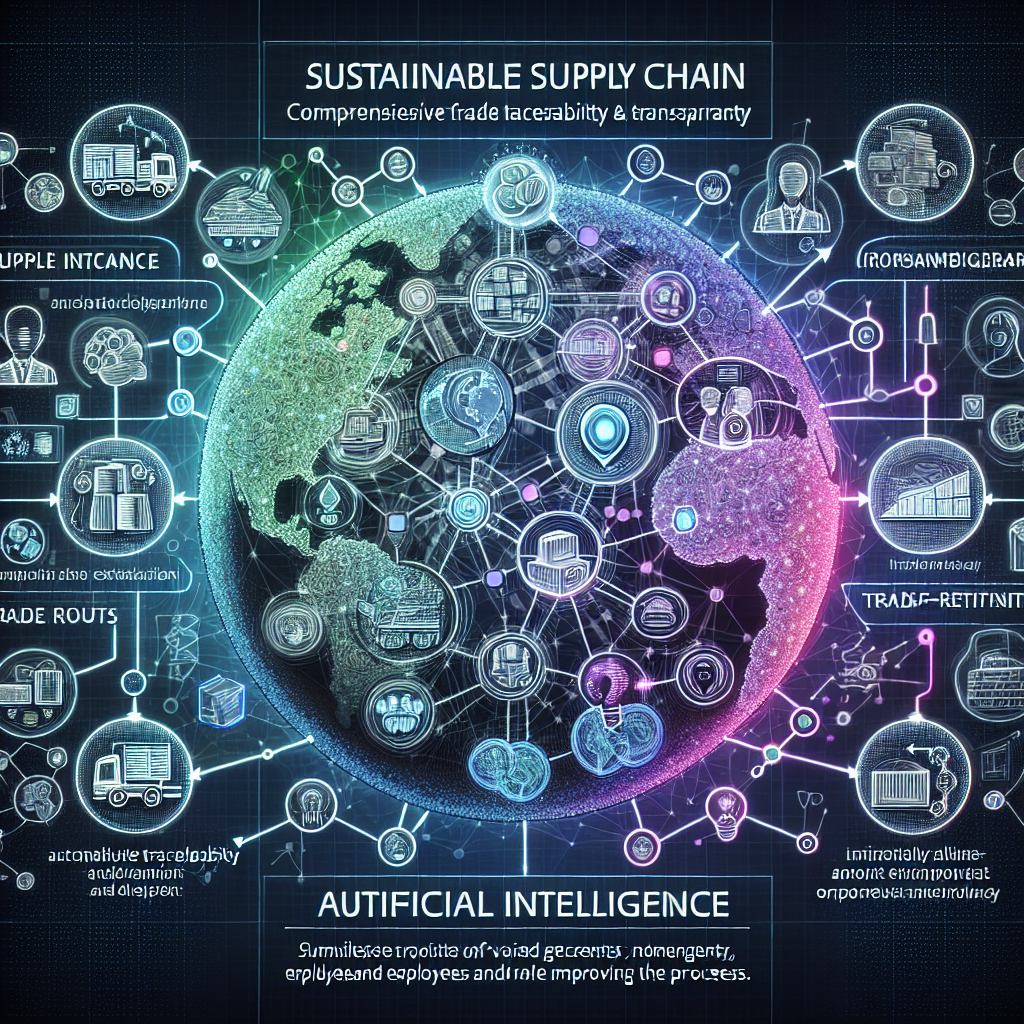
In recent years, there has been a growing focus on sustainability in supply chains. Consumers are increasingly interested in the environmental and social impact of the products they purchase, and companies are under pressure to ensure that their supply chains are transparent and traceable. Leveraging artificial intelligence (AI) can help companies meet these demands by providing greater visibility into their supply chains and enabling them to track and trace products from the source to the consumer.
One of the key challenges in supply chain management is the lack of transparency and visibility into the various stages of production and distribution. This can make it difficult for companies to identify potential issues such as human rights violations, environmental damage, or counterfeit products. AI technologies, such as machine learning and natural language processing, can help address these challenges by analyzing large amounts of data to identify patterns and anomalies in the supply chain.
For example, AI can be used to analyze data from sensors and IoT devices to track the movement of products through the supply chain. This can help companies identify bottlenecks and inefficiencies in the production process, as well as provide real-time updates on the location and condition of products. AI can also be used to analyze social media and news articles to identify potential risks in the supply chain, such as labor disputes or environmental violations.
Another key benefit of leveraging AI for supply chain traceability and transparency is the ability to track the provenance of products. By using blockchain technology, companies can create a tamper-proof record of the origin and journey of a product, from the raw materials to the finished product. This can help companies verify the authenticity of products, as well as ensure compliance with regulations and standards.
Furthermore, AI can help companies optimize their supply chains by predicting demand, identifying cost-saving opportunities, and reducing waste. By analyzing historical data and real-time information, AI algorithms can help companies forecast demand more accurately, reduce excess inventory, and optimize production schedules. This can not only improve efficiency and reduce costs but also reduce the environmental impact of the supply chain.
In addition to improving efficiency and transparency, leveraging AI for sustainable supply chain traceability can also help companies meet the growing demand for sustainable products. Consumers are increasingly looking for products that are ethically sourced, environmentally friendly, and socially responsible. By using AI to track and trace products from the source to the consumer, companies can provide greater visibility into their supply chains and demonstrate their commitment to sustainability.
Overall, leveraging AI for sustainable supply chain traceability and transparency offers numerous benefits for companies, including improved efficiency, greater visibility, and enhanced sustainability. By harnessing the power of AI technologies, companies can better understand their supply chains, identify risks and opportunities, and meet the demands of consumers for transparent and sustainable products.
FAQs:
1. How can AI help improve supply chain traceability?
AI can help improve supply chain traceability by analyzing data from sensors, IoT devices, and other sources to track the movement of products through the supply chain. AI algorithms can identify patterns and anomalies in the data to provide real-time updates on the location and condition of products, as well as identify potential risks in the supply chain.
2. What is blockchain technology and how can it be used for supply chain traceability?
Blockchain technology is a decentralized and tamper-proof record-keeping system that can be used to create a transparent and secure record of the provenance of products. By using blockchain technology, companies can track the origin and journey of a product, from the raw materials to the finished product, to verify authenticity and ensure compliance with regulations.
3. How can AI help companies optimize their supply chains?
AI can help companies optimize their supply chains by analyzing historical data and real-time information to forecast demand more accurately, reduce excess inventory, and optimize production schedules. By identifying cost-saving opportunities and reducing waste, AI algorithms can improve efficiency and reduce costs in the supply chain.
4. How can AI help companies meet the growing demand for sustainable products?
AI can help companies meet the growing demand for sustainable products by providing greater visibility into their supply chains and demonstrating their commitment to sustainability. By tracking and tracing products from the source to the consumer, companies can provide transparency and assurance that their products are ethically sourced, environmentally friendly, and socially responsible.