
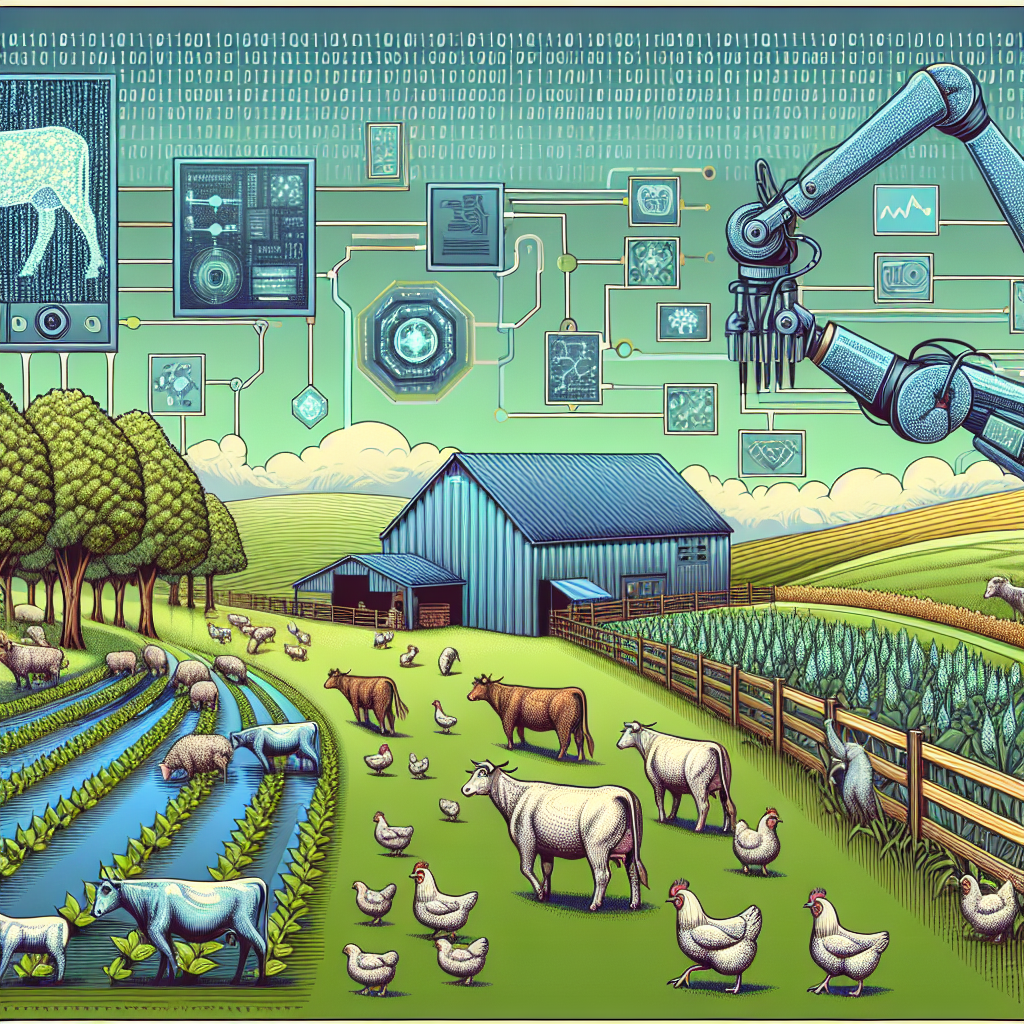
Leveraging AI for Disease Detection in Livestock
Introduction
Livestock farming plays a crucial role in feeding the global population. However, the industry is constantly facing challenges such as disease outbreaks that can have devastating effects on animal health, welfare, and productivity. Detecting diseases in livestock early is essential to prevent the spread of infectious diseases and minimize economic losses for farmers.
Artificial intelligence (AI) has emerged as a powerful tool in disease detection, offering the potential to revolutionize the way diseases are identified and managed in livestock. By leveraging AI technologies such as machine learning and computer vision, farmers and veterinarians can detect diseases earlier, more accurately, and with greater efficiency than traditional methods. In this article, we will explore how AI is being used to detect diseases in livestock, the benefits it offers, and the challenges that must be overcome to fully realize its potential.
How AI is being used for disease detection in livestock
AI technologies are being utilized in various ways to detect diseases in livestock. One of the most common applications is through the use of machine learning algorithms, which can analyze large amounts of data to identify patterns and detect anomalies that may indicate the presence of a disease. For example, researchers have developed machine learning models that can analyze blood samples from livestock to detect diseases such as bovine respiratory disease and foot-and-mouth disease.
Computer vision is another AI technology that is being used to detect diseases in livestock. This technology uses cameras and image analysis algorithms to identify visual cues that may indicate the presence of a disease. For example, researchers have developed computer vision systems that can analyze images of cattle to detect signs of mastitis, a common udder infection that can affect milk production.
AI-powered sensors are also being used to monitor livestock health and detect diseases in real-time. These sensors can collect data on various parameters such as temperature, heart rate, and behavior, and use AI algorithms to analyze this data for signs of disease. For example, researchers have developed wearable sensors that can monitor the movement patterns of livestock to detect early signs of lameness, a common condition that can affect the welfare of animals.
Benefits of using AI for disease detection in livestock
There are several benefits to using AI for disease detection in livestock. One of the key advantages is the ability to detect diseases earlier than traditional methods. AI algorithms can analyze data from multiple sources and identify subtle changes in animal health that may not be apparent to the naked eye. Early detection allows farmers and veterinarians to take action quickly, preventing the spread of disease and minimizing the impact on animal health and productivity.
Another benefit of using AI for disease detection is the ability to analyze large amounts of data quickly and accurately. Traditional methods of disease detection often rely on manual inspection and interpretation of data, which can be time-consuming and prone to human error. AI algorithms can process data at a much faster rate and with greater accuracy, allowing for more efficient and effective disease detection.
AI technologies also have the potential to improve the overall health and welfare of livestock. By detecting diseases early and accurately, farmers and veterinarians can provide timely treatment and care to affected animals, reducing suffering and improving outcomes. In addition, AI-powered monitoring systems can help farmers identify potential health issues before they become serious, allowing for proactive management of animal health.
Challenges of using AI for disease detection in livestock
While AI offers significant potential for disease detection in livestock, there are several challenges that must be overcome to fully realize its benefits. One of the main challenges is the availability of high-quality data for training AI algorithms. Machine learning models require large amounts of labeled data to learn patterns and make accurate predictions. In the case of livestock diseases, collecting and labeling data can be time-consuming and expensive, particularly for rare or emerging diseases.
Another challenge is the need for robust and reliable AI models that can generalize across different livestock species and disease types. AI algorithms trained on data from one type of livestock or disease may not perform well on data from other species or diseases. Developing AI models that are robust and generalizable requires careful selection of data, feature engineering, and validation techniques.
Ethical considerations are also an important challenge in using AI for disease detection in livestock. AI technologies raise concerns about data privacy, algorithm bias, and decision-making transparency. Farmers and veterinarians must ensure that AI systems are used ethically and responsibly, and that decisions made based on AI recommendations are in the best interests of animal welfare.
FAQs
Q: Can AI detect all diseases in livestock?
A: AI technologies have the potential to detect a wide range of diseases in livestock, but their performance may vary depending on the type of disease and the quality of data available for training. AI algorithms are particularly well-suited for detecting diseases that have clear patterns or visual cues, such as respiratory infections or lameness.
Q: How accurate are AI models for disease detection in livestock?
A: The accuracy of AI models for disease detection in livestock depends on various factors, including the quality of data, the complexity of the disease, and the robustness of the AI algorithm. In general, AI models can achieve high levels of accuracy for detecting common diseases in livestock, but their performance may vary for rare or emerging diseases.
Q: How can farmers and veterinarians implement AI for disease detection in livestock?
A: Implementing AI for disease detection in livestock requires access to high-quality data, expertise in AI technologies, and a commitment to ethical and responsible use of AI systems. Farmers and veterinarians can collaborate with researchers, technology providers, and industry partners to develop and deploy AI-powered solutions for disease detection in livestock.
Conclusion
AI technologies have the potential to revolutionize disease detection in livestock, offering the ability to detect diseases earlier, more accurately, and with greater efficiency than traditional methods. By leveraging machine learning, computer vision, and sensor technologies, farmers and veterinarians can monitor livestock health in real-time, identify signs of disease, and take prompt action to prevent the spread of infectious diseases and minimize economic losses. While there are challenges to overcome in implementing AI for disease detection in livestock, the benefits of using AI for disease detection are clear, and the potential to improve animal health and welfare is significant.