
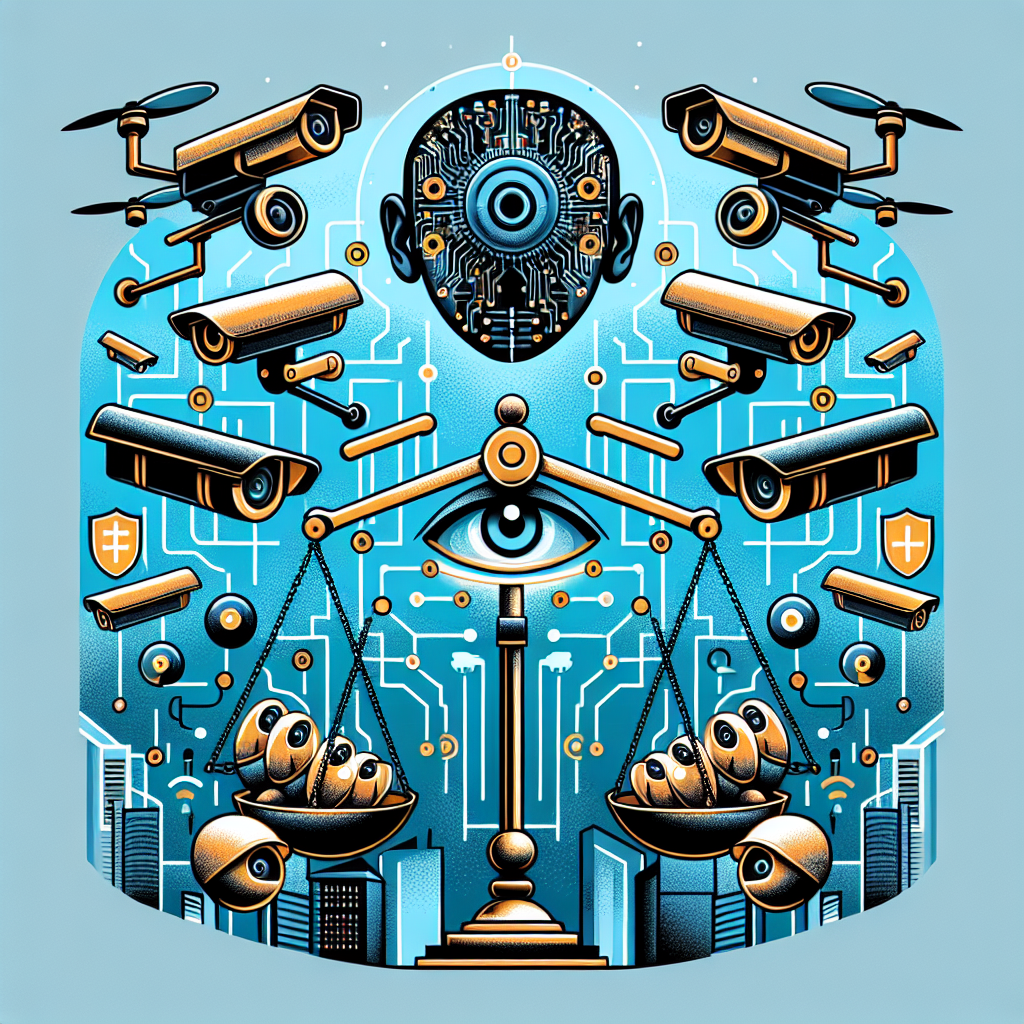
Artificial Intelligence (AI) has revolutionized many industries, including the security industry. With the increasing use of AI technologies in surveillance and monitoring systems, there are significant implications on government surveillance and privacy rights. While AI can enhance security measures and help prevent crime, it also raises concerns about invasion of privacy and potential misuse of data. In this article, we will explore the implications of AI on government surveillance and privacy rights in the security industry.
AI in Government Surveillance
Government agencies around the world are increasingly turning to AI technology to enhance their surveillance capabilities. AI-powered surveillance systems can analyze vast amounts of data in real-time, identify patterns, and detect suspicious behavior. These systems can be used for various purposes, including monitoring public spaces, tracking individuals, and predicting criminal activities.
One of the main advantages of AI in government surveillance is its ability to improve efficiency and accuracy. AI algorithms can process data much faster than humans, enabling authorities to respond to potential threats more quickly. AI can also help automate surveillance tasks, freeing up human resources for other important tasks.
However, the use of AI in government surveillance also raises concerns about privacy rights. The widespread deployment of surveillance cameras equipped with facial recognition technology, for example, has sparked debates about the impact on individual privacy. Critics argue that such technologies can be used to track and monitor individuals without their consent, leading to a surveillance state where citizens are constantly under scrutiny.
Privacy Rights in the Security Industry
Privacy rights are enshrined in many constitutions and legal frameworks around the world. Individuals have the right to privacy and protection of their personal data, and governments are bound by laws and regulations to respect these rights. However, the use of AI in the security industry has raised new challenges for privacy rights.
One of the main concerns is the collection and storage of personal data by AI-powered surveillance systems. These systems can capture and analyze a wide range of data, including facial images, biometric information, and behavioral patterns. This data can be used to track individuals, monitor their activities, and even predict their future behavior.
The collection of such sensitive data raises questions about data privacy and security. Who has access to this data? How is it stored and protected? Can it be used for purposes other than security surveillance? These are important questions that need to be addressed to ensure that privacy rights are respected in the security industry.
Implications of AI on Privacy Rights
The use of AI in government surveillance has significant implications for privacy rights. While AI technologies can enhance security measures and help prevent crime, they also pose risks to individual privacy. The widespread deployment of AI-powered surveillance systems can lead to increased surveillance of individuals, tracking of their activities, and potential misuse of personal data.
One of the key concerns is the lack of transparency and accountability in AI-powered surveillance systems. Many of these systems operate in a black box, with algorithms making decisions that are not easily understandable or explainable. This lack of transparency can lead to biases and errors in the surveillance process, potentially violating privacy rights.
Another concern is the potential for surveillance creep, where the scope of surveillance expands beyond its original purpose. AI-powered surveillance systems can collect vast amounts of data on individuals, which can be used for purposes other than security surveillance. This data can be shared with other government agencies, law enforcement authorities, or even private companies, raising concerns about data misuse and privacy violations.
Furthermore, the use of AI in government surveillance can lead to mass surveillance of entire populations. AI technologies can analyze data from multiple sources, including social media, internet browsing history, and mobile phone records, to create detailed profiles of individuals. This level of surveillance can erode privacy rights and undermine individual autonomy.
FAQs:
Q: Can AI-powered surveillance systems be used to infringe on privacy rights?
A: Yes, AI-powered surveillance systems have the potential to infringe on privacy rights by tracking individuals, monitoring their activities, and collecting sensitive personal data without their consent.
Q: How can privacy rights be protected in the security industry?
A: Privacy rights can be protected in the security industry by implementing strict data protection laws and regulations, ensuring transparency and accountability in surveillance practices, and conducting regular audits and oversight of AI-powered surveillance systems.
Q: What are the risks of mass surveillance using AI technologies?
A: The risks of mass surveillance using AI technologies include invasion of privacy, erosion of individual autonomy, potential misuse of personal data, and the creation of a surveillance state where citizens are constantly under scrutiny.
Q: How can individuals protect their privacy in the age of AI surveillance?
A: Individuals can protect their privacy in the age of AI surveillance by being aware of the risks, limiting their exposure to surveillance technologies, using encryption and secure communication channels, and advocating for stronger data protection laws and regulations.
In conclusion, the implications of AI on government surveillance and privacy rights in the security industry are complex and multifaceted. While AI technologies can enhance security measures and help prevent crime, they also raise concerns about invasion of privacy, potential misuse of data, and erosion of individual autonomy. It is crucial for governments, regulatory bodies, and technology companies to address these concerns and ensure that privacy rights are respected in the age of AI-powered surveillance.