
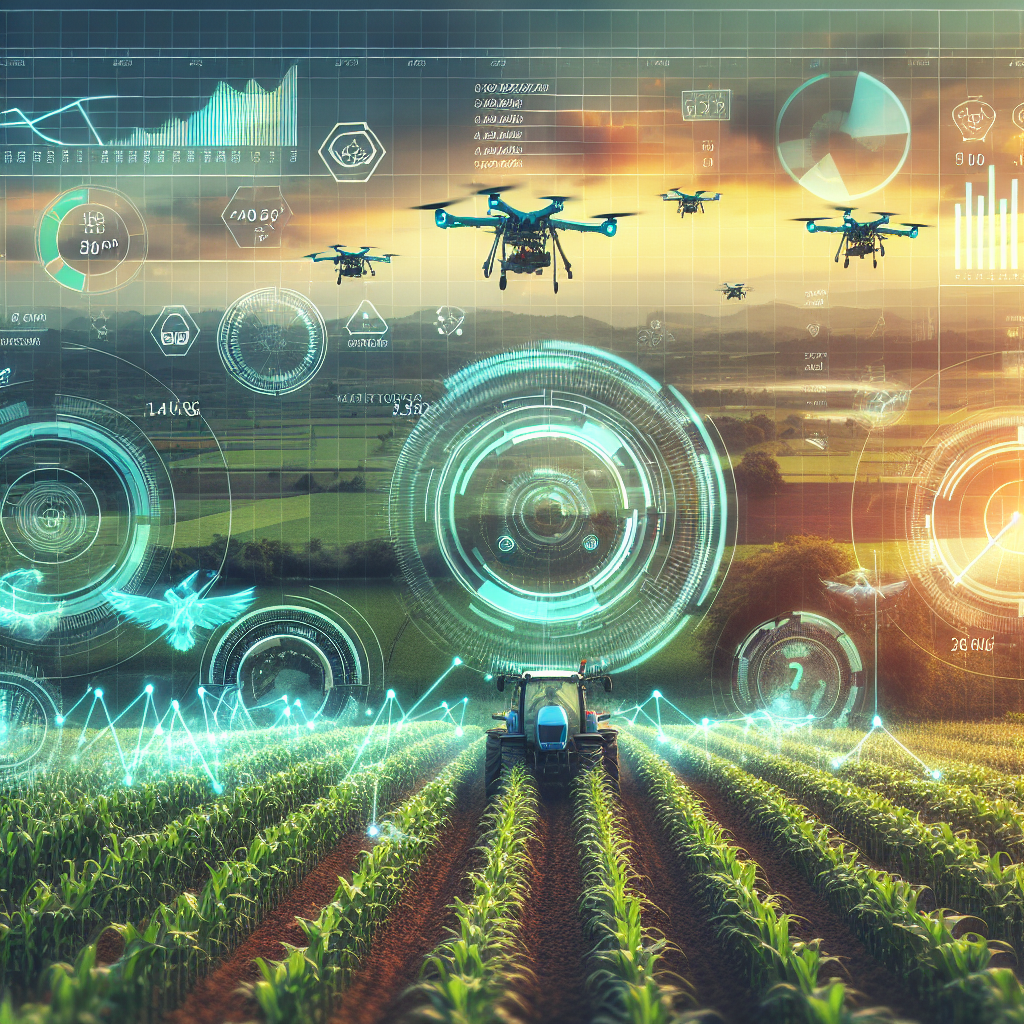
AI Applications in Agricultural Market Forecasting
Artificial Intelligence (AI) has become a game-changer in various industries, and the agricultural sector is no exception. With the help of AI technologies, farmers and agricultural businesses can now make more informed decisions based on data-driven insights. One of the key areas where AI is making a significant impact is in agricultural market forecasting.
Market forecasting in agriculture is crucial for farmers, traders, and other stakeholders to make informed decisions about planting, harvesting, pricing, and supply chain management. Traditionally, market forecasting relied on historical data, expert opinions, and basic statistical models. However, with the advent of AI, more sophisticated forecasting models can be developed that take into account a wide range of variables and factors that influence agricultural markets.
AI technologies such as machine learning, deep learning, and neural networks are being used to analyze vast amounts of data from various sources such as weather patterns, soil quality, crop yields, market trends, and consumer behavior. By processing this data, AI algorithms can identify patterns, trends, and correlations that are not easily visible to human analysts. This allows for more accurate and timely market forecasts that can help farmers and other stakeholders make better decisions.
One of the key benefits of using AI in agricultural market forecasting is its ability to provide real-time insights. Traditional forecasting methods often rely on outdated data or assumptions that may no longer be relevant. With AI, data can be continuously updated and analyzed in real-time, allowing for more accurate and up-to-date forecasts.
Another benefit of using AI in market forecasting is its ability to handle large and complex datasets. Agricultural markets are influenced by a wide range of factors such as weather conditions, commodity prices, government policies, and global market trends. AI algorithms are able to process and analyze these complex datasets much faster and more effectively than traditional methods, leading to more accurate and reliable forecasts.
AI technologies are also being used to develop predictive models that can forecast market trends and prices with a high degree of accuracy. These models can take into account a wide range of variables and factors, allowing for more comprehensive and nuanced forecasts. This can help farmers and other stakeholders make better decisions about when to plant, harvest, buy, sell, or store their crops.
In addition to market forecasting, AI is also being used to optimize supply chain management in agriculture. By analyzing data on crop yields, transportation costs, storage capacity, and market demand, AI algorithms can help farmers and agribusinesses make more efficient and cost-effective decisions about how to distribute their products. This can lead to lower costs, higher profits, and better market outcomes for all stakeholders.
Overall, the use of AI in agricultural market forecasting is revolutionizing the way farmers and agribusinesses make decisions. By leveraging the power of AI technologies, stakeholders in the agricultural sector can access more accurate, timely, and comprehensive market forecasts that can help them navigate the complexities of the agricultural market with greater confidence and success.
FAQs:
Q: How does AI help in agricultural market forecasting?
A: AI technologies such as machine learning, deep learning, and neural networks analyze vast amounts of data from various sources to identify patterns, trends, and correlations that influence agricultural markets. This allows for more accurate and timely market forecasts.
Q: What are the benefits of using AI in market forecasting?
A: AI provides real-time insights, can handle large and complex datasets, and develops predictive models that forecast market trends and prices with a high degree of accuracy. AI also helps optimize supply chain management in agriculture.
Q: How does AI improve supply chain management in agriculture?
A: By analyzing data on crop yields, transportation costs, storage capacity, and market demand, AI algorithms can help farmers and agribusinesses make more efficient and cost-effective decisions about how to distribute their products.
Q: How can farmers and agribusinesses benefit from AI in agricultural market forecasting?
A: AI enables stakeholders in the agricultural sector to access more accurate, timely, and comprehensive market forecasts that can help them make better decisions about planting, harvesting, pricing, and supply chain management. This can lead to higher profits and better market outcomes.