
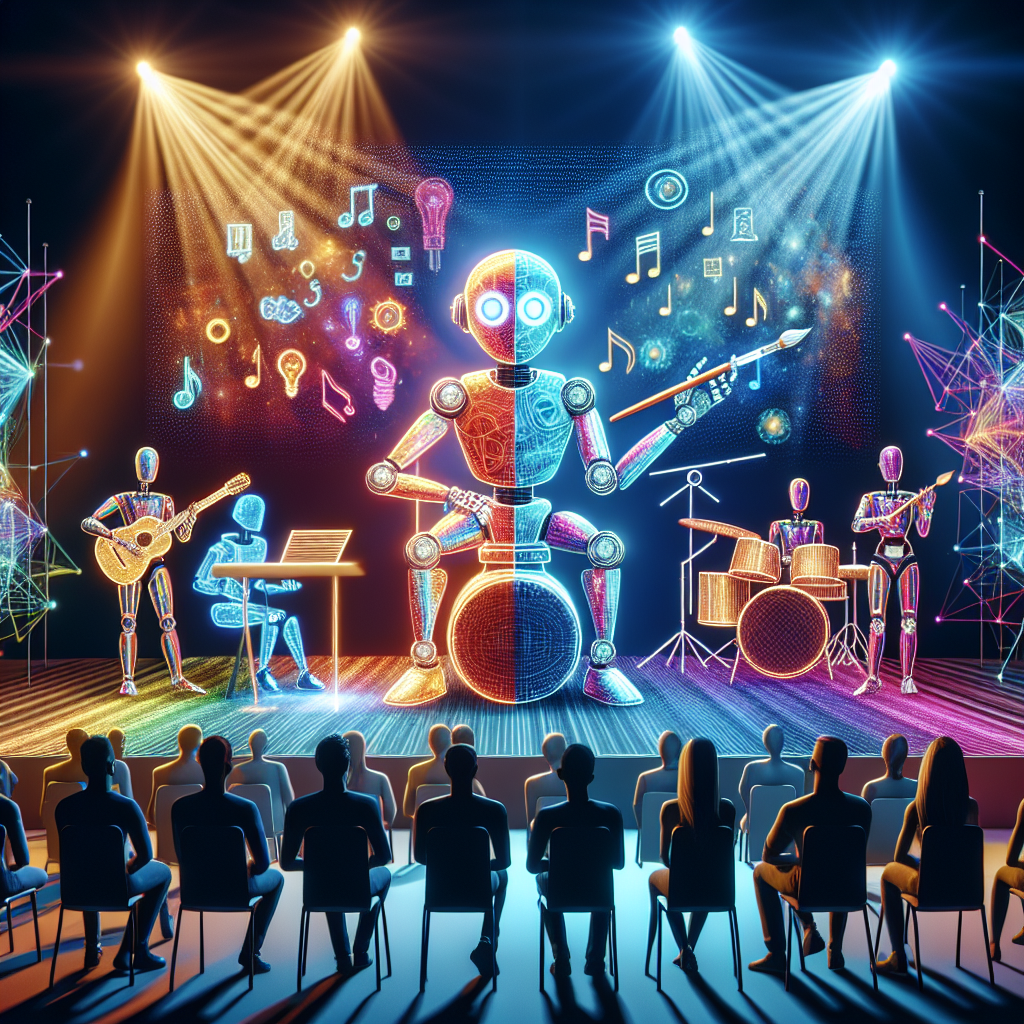
The Future of Creativity: AI Takes the Stage
In recent years, artificial intelligence (AI) has made significant strides in various fields, including healthcare, finance, and transportation. One area where AI is increasingly making its presence felt is in the creative industry. From music composition to visual arts, AI is playing a crucial role in shaping the future of creativity.
AI and Creativity
AI algorithms are capable of analyzing large amounts of data to identify patterns and generate new ideas. In the creative industry, this ability can be harnessed to create music, art, and even literature. For example, AI-powered platforms like Amper Music and Aiva can compose original music tracks based on user inputs. These platforms use machine learning algorithms to analyze popular music styles and generate new compositions that sound remarkably human-like.
Similarly, AI can also be used to create visual art. The Google Arts & Culture platform, for instance, has developed an AI-powered tool called Art Palette that can match colors in a photograph to famous artworks. This tool can help artists and designers find inspiration for their own projects by generating color palettes based on existing works of art.
AI is also making inroads in the world of literature. OpenAI, a research institute focused on developing AI technologies, has created GPT-3, a language model that can generate coherent and contextually relevant text. This model can be used to write articles, stories, and even poetry. In fact, GPT-3 has been so successful at mimicking human writing that it has raised concerns about the potential for AI to replace human writers.
The Impact of AI on Creativity
The rise of AI in the creative industry has sparked a debate about the impact of technology on human creativity. Some argue that AI can enhance creativity by providing artists with new tools and resources to explore their ideas. For example, AI-powered platforms can help artists generate ideas quickly and efficiently, freeing up more time for them to focus on the creative process.
On the other hand, some critics worry that AI could replace human creativity altogether. They argue that AI-generated art and music lack the emotional depth and authenticity that comes from human experience. While AI algorithms can mimic certain aspects of creativity, they may never be able to replicate the unique perspective and intuition that humans bring to the creative process.
Despite these concerns, many artists and creators are embracing AI as a tool to enhance their work. By collaborating with AI algorithms, artists can explore new techniques and styles that they may not have considered otherwise. In this way, AI can act as a catalyst for creativity, pushing artists to think outside the box and experiment with new ideas.
The Future of AI in Creativity
As AI continues to evolve, its role in the creative industry is likely to grow. In the future, we may see AI-powered platforms that can create entire films, novels, and artworks from scratch. These platforms could revolutionize the way we consume and produce creative content, blurring the lines between human and machine-generated art.
One area where AI is poised to make a significant impact is in personalized content creation. AI algorithms can analyze user data to create customized music playlists, art recommendations, and even personalized stories. This level of personalization could transform the way we interact with creative content, making it more tailored to our individual preferences and tastes.
Another exciting development in the world of AI and creativity is the rise of generative adversarial networks (GANs). GANs are a type of AI algorithm that can generate realistic images, music, and text by learning from existing data. These algorithms can create new and original content that is indistinguishable from human-generated work, leading to a new era of AI-powered creativity.
FAQs
Q: Can AI truly be creative?
A: While AI algorithms can generate new ideas and content, some argue that true creativity requires human intuition and emotion. AI can mimic creativity to a certain extent, but it may never be able to replicate the depth and complexity of human creativity.
Q: Will AI replace human artists?
A: While AI has the potential to enhance and augment human creativity, it is unlikely to replace human artists altogether. AI-generated art and music lack the emotional depth and authenticity that comes from human experience, making human artists indispensable in the creative process.
Q: How can artists collaborate with AI?
A: Artists can collaborate with AI by using AI-powered platforms to generate ideas, experiment with new techniques, and explore different styles. By incorporating AI into their creative process, artists can push the boundaries of their work and discover new possibilities.
Q: What are the ethical implications of AI in creativity?
A: The rise of AI in the creative industry raises ethical concerns about the ownership of AI-generated content, the impact of AI on human creativity, and the potential for bias in AI algorithms. It is important for artists, creators, and technologists to address these issues and ensure that AI is used responsibly and ethically in the creative process.
In conclusion, the future of creativity is evolving with the rise of AI. While AI has the potential to enhance and augment human creativity, it also raises important questions about the impact of technology on human expression. By embracing AI as a tool for creativity, artists and creators can explore new possibilities and push the boundaries of their work. As AI continues to evolve, it is essential for us to consider the ethical implications of AI in creativity and ensure that technology is used responsibly to support and enhance human creativity.