
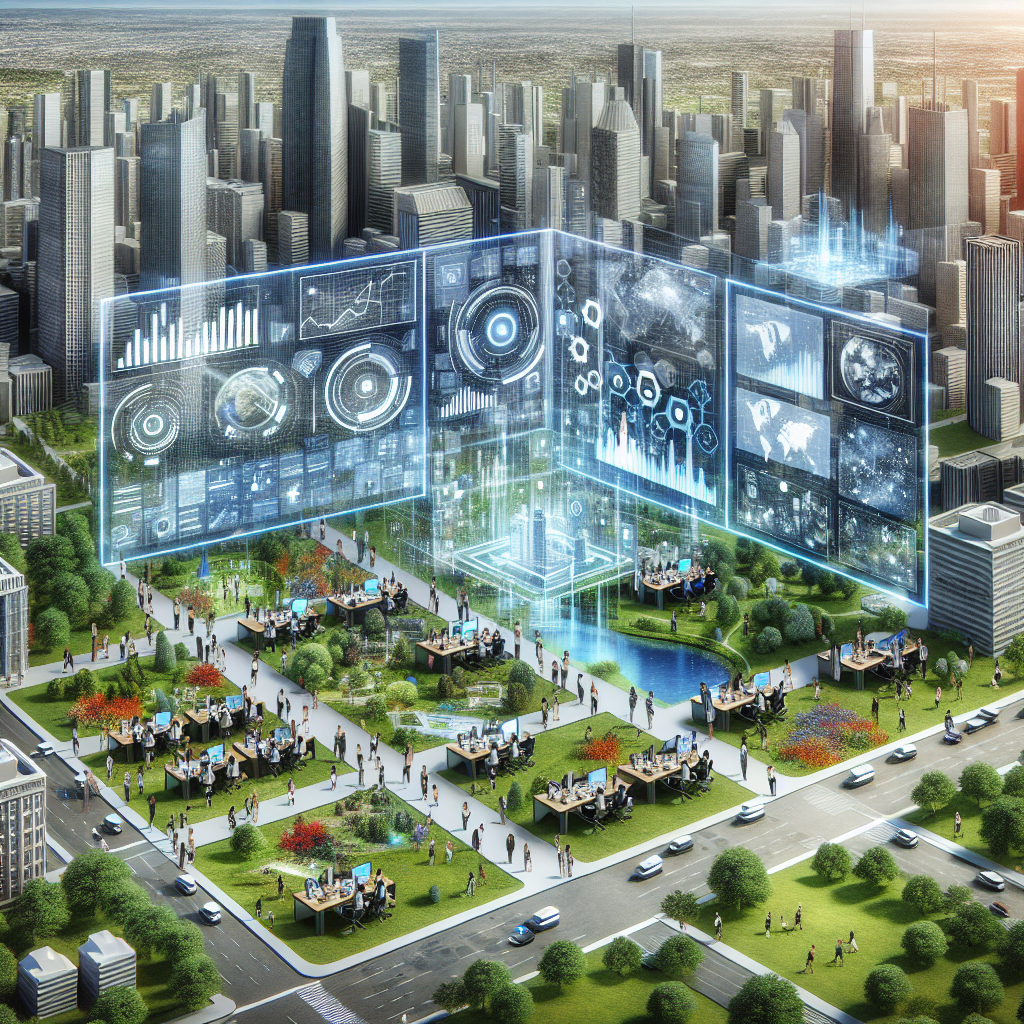
In recent years, the rapid urbanization of cities around the world has posed significant challenges for sustainable development. As populations continue to grow, the need for effective urban planning becomes more crucial in order to ensure that cities are able to support their residents in a sustainable way. Leveraging artificial intelligence (AI) can play a key role in addressing these challenges and creating more sustainable urban environments.
AI has the potential to revolutionize the way cities are planned and managed, by providing valuable insights and predictions that can help inform decision-making processes. By analyzing large amounts of data, AI algorithms can identify patterns and trends that can be used to optimize urban planning strategies. This can help city planners make more informed decisions about infrastructure development, transportation systems, energy consumption, and other key aspects of urban life.
One of the key benefits of using AI in urban planning is its ability to improve efficiency and reduce costs. By automating certain tasks, such as data analysis and forecasting, AI can help cities make better use of their resources and allocate them more effectively. This can lead to significant cost savings and improved overall performance in urban planning projects.
AI can also help cities become more sustainable by optimizing their energy usage and reducing their carbon footprint. By analyzing data on energy consumption patterns, AI algorithms can identify opportunities for energy efficiency improvements and help cities develop more sustainable energy strategies. This can help reduce greenhouse gas emissions and mitigate the impacts of climate change.
In addition, AI can help cities improve their transportation systems and reduce traffic congestion. By analyzing traffic data and predicting future trends, AI algorithms can help optimize traffic flow and identify areas where improvements can be made. This can help cities reduce their reliance on cars and promote more sustainable modes of transportation, such as public transit and cycling.
Overall, leveraging AI for sustainable urban planning can help cities become more resilient, efficient, and environmentally friendly. By harnessing the power of AI, cities can make smarter decisions that benefit both their residents and the environment.
FAQs
Q: How can AI help cities improve their energy efficiency?
A: AI algorithms can analyze data on energy consumption patterns and identify opportunities for energy efficiency improvements. This can help cities develop more sustainable energy strategies and reduce their overall carbon footprint.
Q: Can AI help reduce traffic congestion in cities?
A: Yes, AI algorithms can analyze traffic data and predict future trends to help optimize traffic flow and reduce congestion. This can lead to more efficient transportation systems and reduce the reliance on cars.
Q: What are some examples of cities using AI for sustainable urban planning?
A: Several cities around the world are already using AI to improve their urban planning strategies. For example, Singapore has implemented AI algorithms to optimize its transportation systems and reduce traffic congestion. Barcelona has also used AI to improve energy efficiency and reduce its carbon footprint.
Q: What are some of the challenges of using AI for urban planning?
A: One of the main challenges of using AI for urban planning is ensuring the accuracy and reliability of the data being analyzed. Additionally, there may be concerns about privacy and data security when using AI algorithms to analyze sensitive information. It is important for cities to address these challenges in order to fully leverage the potential of AI for sustainable urban planning.