
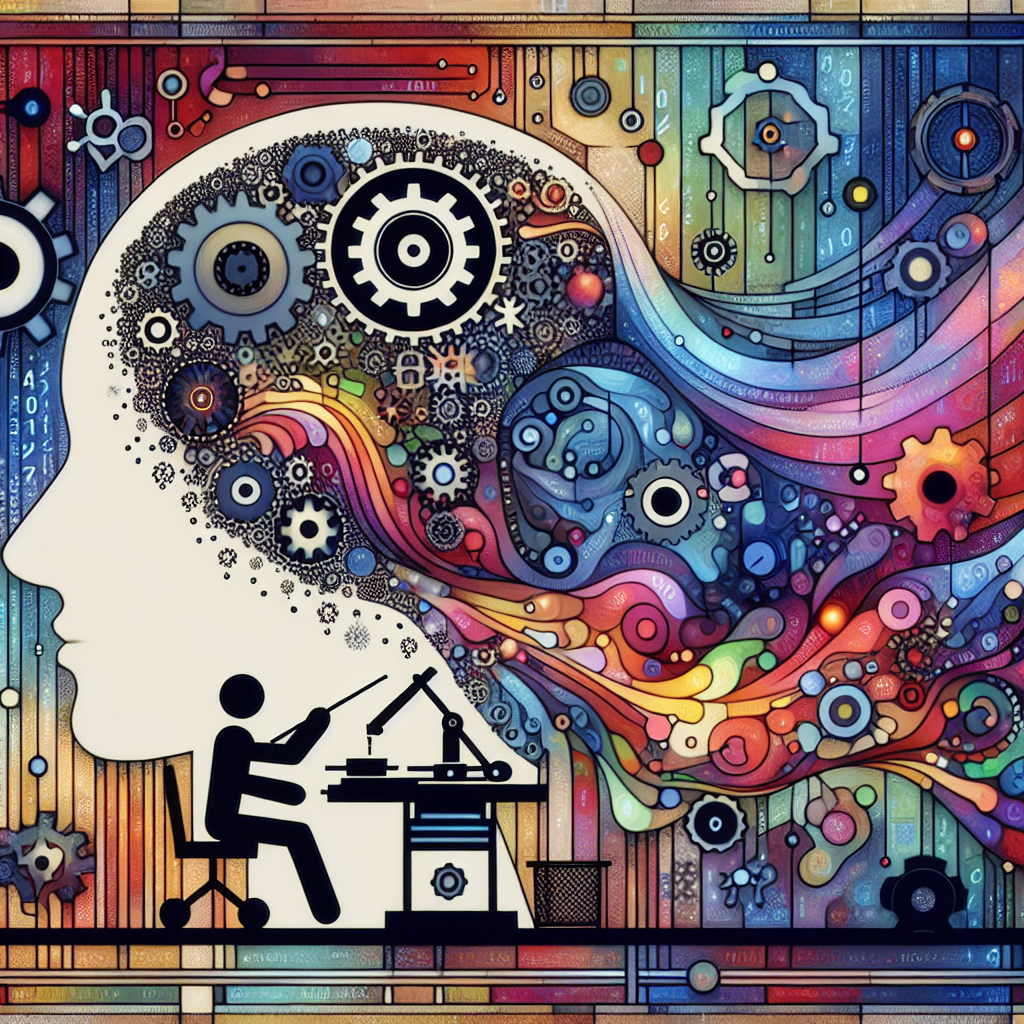
Artificial Intelligence (AI) has made significant advancements in recent years, pushing the boundaries of what was once thought possible. One area where AI is making a big impact is in the realm of creativity. While traditionally, creativity was thought to be a uniquely human trait, AI is now proving that it too can be creative, pushing the limits of imagination and challenging our preconceived notions of what is possible.
AI and Creativity
Creativity is often defined as the ability to generate new ideas, concepts, or solutions that are novel, useful, and valuable. It involves thinking outside the box, making connections between seemingly unrelated ideas, and coming up with innovative solutions to problems. For a long time, creativity was seen as something that only humans could do, as it was thought to require a level of intuition, imagination, and emotion that machines simply couldn’t replicate.
However, with the advent of AI, that notion is being challenged. AI systems are now being used to create music, art, literature, and other forms of creative expression that rival those made by humans. These AI systems are able to analyze vast amounts of data, recognize patterns, and generate new ideas in ways that are often faster and more efficient than humans. This has led to a new era of creativity, where AI is being used to push the limits of what is possible in the realm of imagination.
AI and Music
One area where AI is making a big impact is in the field of music. AI systems are now able to compose music, play musical instruments, and even improvise in ways that were once thought to be the sole domain of human musicians. For example, AI systems like Google’s Magenta and IBM’s Watson Beat are able to generate melodies, harmonies, and rhythms that are indistinguishable from those created by human composers.
AI is also being used to create new genres of music that blend elements from different styles and traditions. For example, AI systems like AIVA are able to compose music that fuses classical, electronic, and pop music in ways that are both innovative and exciting. These new genres of music are challenging our preconceived notions of what is possible in the realm of creativity, pushing the boundaries of imagination and opening up new possibilities for musical expression.
AI and Art
AI is also making a big impact in the world of art. AI systems are now able to create visual art, sculpture, and other forms of artistic expression that rival those made by human artists. For example, AI systems like DeepDream and DeepArt are able to generate images that are both aesthetically pleasing and emotionally evocative.
AI is also being used to create new forms of art that blend elements from different styles and traditions. For example, AI systems like the Creativity Machine are able to create art that fuses elements from surrealism, cubism, and abstract expressionism in ways that are both innovative and thought-provoking. These new forms of art challenge our preconceived notions of what is possible in the realm of creativity, pushing the limits of imagination and expanding the boundaries of artistic expression.
AI and Literature
AI is also making a big impact in the world of literature. AI systems are now able to write novels, poems, and other forms of written expression that rival those created by human authors. For example, AI systems like OpenAI’s GPT-3 are able to generate text that is both grammatically correct and stylistically coherent.
AI is also being used to create new forms of literature that blend elements from different genres and traditions. For example, AI systems like Botnik are able to generate stories that mix elements from science fiction, fantasy, and mystery in ways that are both engaging and surprising. These new forms of literature challenge our preconceived notions of what is possible in the realm of creativity, pushing the limits of imagination and opening up new possibilities for literary expression.
FAQs
Q: Can AI truly be creative?
A: While AI systems may not possess the same level of intuition, imagination, and emotion as humans, they are still able to generate new ideas, concepts, and solutions that are novel, useful, and valuable. This ability to think outside the box and make connections between seemingly unrelated ideas is what we traditionally think of as creativity, and AI systems are proving that they too can be creative in their own way.
Q: How does AI generate creative ideas?
A: AI systems generate creative ideas by analyzing vast amounts of data, recognizing patterns, and generating new ideas based on those patterns. This process is often done through machine learning algorithms that are trained on large datasets of creative works, allowing the AI system to learn the rules and patterns of creativity and generate new ideas that are in line with those rules and patterns.
Q: Can AI replace human creativity?
A: While AI systems are able to generate creative ideas, they are still limited by the data they are trained on and the algorithms they use. Human creativity is often driven by intuition, emotion, and personal experience, things that AI systems struggle to replicate. While AI can be a powerful tool for enhancing human creativity, it is unlikely to fully replace it.
Q: What are the ethical implications of AI and creativity?
A: The use of AI in the realm of creativity raises a number of ethical questions, such as who owns the creative works generated by AI systems, how should credit be given to AI-generated works, and what are the implications for human creativity and artistic expression. These are complex questions that will require careful consideration and discussion as AI continues to push the limits of imagination and creativity.
In conclusion, AI is pushing the limits of imagination and creativity in ways that were once thought to be impossible. From music to art to literature, AI systems are proving that they too can be creative, challenging our preconceived notions of what is possible and opening up new possibilities for creative expression. While there are still many questions to be answered about the role of AI in creativity, one thing is clear: AI is changing the way we think about creativity and pushing the boundaries of what is possible.