
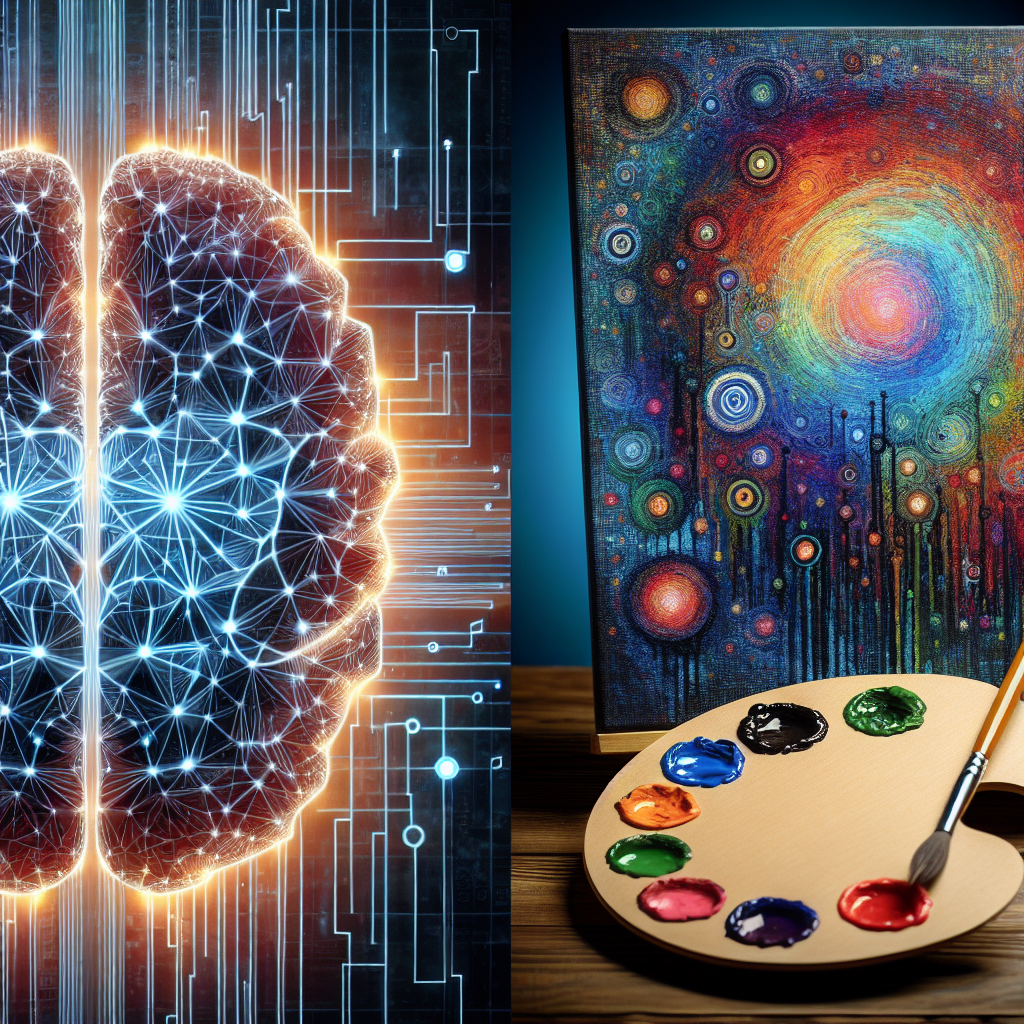
Artificial Intelligence (AI) has made significant advancements in recent years, with its applications expanding into various industries including healthcare, finance, and entertainment. One of the most intriguing uses of AI is in the realm of creative expression. AI has the potential to revolutionize how we create art, music, literature, and other forms of creative content.
AI as a tool for creative expression involves using machine learning algorithms to generate new and innovative content. These algorithms are trained on vast amounts of data, allowing them to learn patterns and generate new content based on these patterns. In the context of art, AI can be used to create visual art, music compositions, and even write poetry.
One of the most famous examples of AI in creative expression is the artwork created by the artist and programmer, Mario Klingemann. Klingemann uses AI algorithms to generate art pieces that blur the lines between human and machine creativity. His work has been showcased in galleries around the world and has sparked a debate about the role of AI in the art world.
In the music industry, AI is also making waves. Companies like Amper Music and Jukedeck are using AI algorithms to compose music tracks for videos, games, and other media. These algorithms can generate music in a matter of minutes, saving time and resources for content creators.
AI is also being used in literature and writing. OpenAI’s GPT-3 (Generative Pre-trained Transformer 3) is a language model that can generate human-like text based on the input it receives. This has led to the development of AI-powered writing assistants that can help writers with brainstorming ideas, generating content, and even editing drafts.
Overall, AI as a tool for creative expression has the potential to democratize the creative process, allowing anyone with access to AI tools to create art, music, and writing. However, there are also concerns about the impact of AI on creativity and the role of human artists in a world dominated by machines.
FAQs
Q: Can AI truly be creative?
A: The debate about whether AI can be truly creative is ongoing. While AI algorithms can generate new and innovative content based on patterns in data, some argue that true creativity involves human emotions, experiences, and intentions that machines cannot replicate. However, AI has shown the ability to create art, music, and writing that is indistinguishable from human-created content.
Q: How is AI used in art?
A: AI is used in art to generate visual art pieces, music compositions, and even poetry. Artists and programmers use machine learning algorithms to create art pieces that push the boundaries of human creativity. AI-generated art has been showcased in galleries around the world and has sparked a debate about the role of AI in the art world.
Q: Can AI replace human artists?
A: While AI has the potential to create art, music, and writing, it is unlikely to completely replace human artists. Human creativity involves emotions, experiences, and intentions that machines cannot replicate. AI can be used as a tool to enhance human creativity, but the role of human artists in the creative process is still essential.
Q: Are there ethical concerns about AI in creative expression?
A: There are ethical concerns about AI in creative expression, including issues of copyright, ownership, and authenticity. As AI algorithms generate content based on patterns in data, there are questions about who owns the rights to the content and how it should be attributed. There are also concerns about the impact of AI on creativity and the role of human artists in a world dominated by machines.