
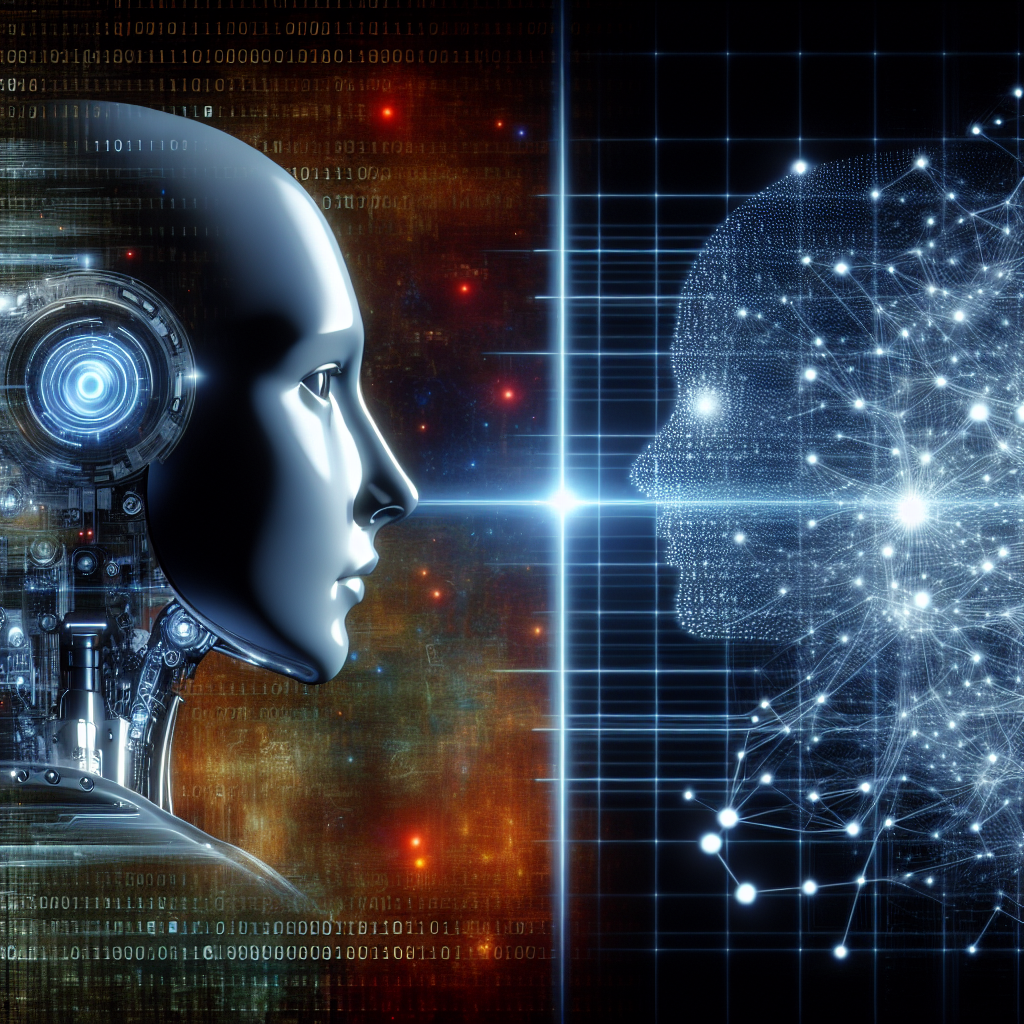
Artificial Intelligence (AI) and Machine Learning (ML) are two closely related concepts that are often used interchangeably in discussions about technology and innovation. While both AI and ML involve the use of algorithms to perform tasks that would typically require human intelligence, there are key differences between the two that are important to understand.
AI is a broad field of computer science that aims to create machines that can perform tasks that typically require human intelligence, such as speech recognition, decision-making, and problem-solving. AI systems are designed to simulate human cognitive functions and to learn from their experiences in order to improve their performance over time.
On the other hand, ML is a subset of AI that focuses on the development of algorithms that can learn from and make predictions or decisions based on data. ML algorithms are designed to analyze large amounts of data in order to identify patterns and make predictions or decisions without being explicitly programmed to do so.
In essence, AI is the broader concept of creating machines that can perform tasks that require human intelligence, while ML is a specific approach within the field of AI that focuses on developing algorithms that can learn from data.
Key Concepts of AI and ML:
1. Training Data: In ML, algorithms are trained on a large amount of data in order to learn patterns and make predictions. The quality and quantity of training data are crucial to the performance of ML algorithms.
2. Algorithms: ML algorithms are the mathematical models that are used to analyze data and make predictions or decisions. There are many different types of ML algorithms, each suited to different types of tasks.
3. Supervised vs. Unsupervised Learning: In supervised learning, ML algorithms are trained on labeled data, where the correct output is provided for each input. In unsupervised learning, algorithms are trained on unlabeled data and must learn patterns and relationships on their own.
4. Neural Networks: Neural networks are a type of ML algorithm that is inspired by the structure of the human brain. They are particularly well-suited to tasks such as image and speech recognition.
5. Deep Learning: Deep learning is a subset of ML that involves the use of neural networks with multiple layers. Deep learning has been particularly successful in tasks such as image and speech recognition.
6. Reinforcement Learning: Reinforcement learning is a type of ML where algorithms learn by interacting with an environment and receiving feedback in the form of rewards or penalties. This approach is often used in tasks such as game playing and robotics.
FAQs:
1. What are the differences between AI and ML?
AI is the broader concept of creating machines that can perform tasks that typically require human intelligence, while ML is a specific approach within the field of AI that focuses on developing algorithms that can learn from data.
2. How are AI and ML used in real-world applications?
AI and ML are used in a wide range of real-world applications, including self-driving cars, recommendation systems, fraud detection, and speech recognition.
3. What are some common challenges in AI and ML?
Some common challenges in AI and ML include the need for large amounts of high-quality training data, the interpretability of ML algorithms, and the potential for bias in AI systems.
4. How are AI and ML shaping the future of technology?
AI and ML are shaping the future of technology by enabling machines to perform tasks that were previously only possible for humans, such as speech recognition, decision-making, and problem-solving. These technologies have the potential to revolutionize industries and improve the quality of life for people around the world.
In conclusion, AI and ML are two closely related concepts that are transforming the way we think about technology and innovation. While AI is the broader concept of creating machines that can perform tasks that typically require human intelligence, ML is a specific approach within the field of AI that focuses on developing algorithms that can learn from data. By understanding the key concepts of AI and ML, we can better appreciate the potential of these technologies to shape the future of our world.