
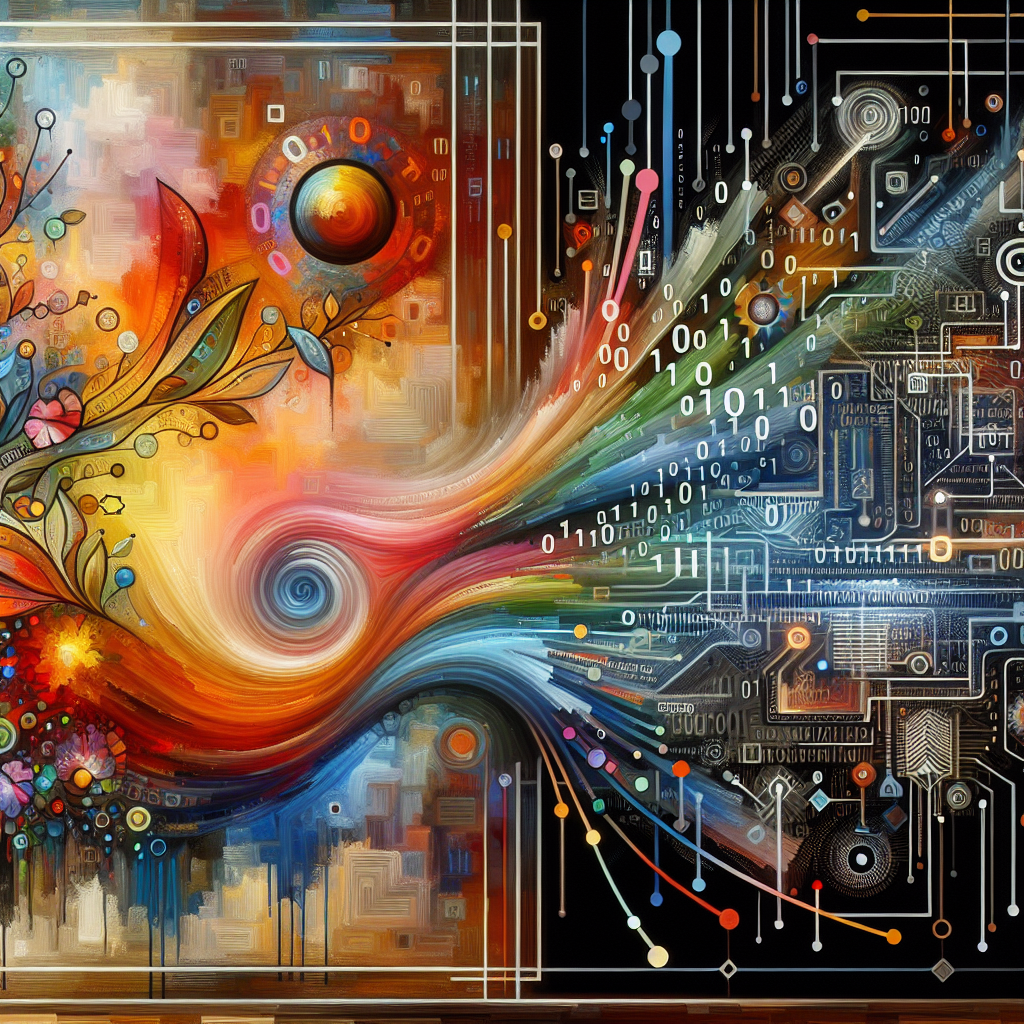
From Code to Canvas: AI’s Impact on Creativity
Artificial intelligence (AI) has been revolutionizing various aspects of our lives, from healthcare to transportation. But perhaps one of the most fascinating areas where AI is making significant strides is in the world of creativity. AI is increasingly being used to assist and enhance the creative process, whether it’s in music composition, writing, or even visual arts. In this article, we will explore the impact of AI on creativity, specifically in the realm of visual arts, and how it is changing the way we think about art and the creative process.
AI in Visual Arts
AI has been making waves in the world of visual arts for several years now. From creating digital art to assisting in the creation of traditional paintings, AI is playing an increasingly important role in the creative process. One of the most well-known examples of AI in visual arts is the use of Generative Adversarial Networks (GANs) to generate realistic images. GANs are a type of AI architecture that consists of two neural networks, a generator and a discriminator, that work together to produce images that are indistinguishable from real ones.
Another area where AI is making an impact in visual arts is in the creation of new and innovative artworks. Artists and designers are using AI tools and algorithms to explore new creative possibilities and push the boundaries of traditional art forms. For example, AI can be used to generate complex patterns and designs that would be difficult or impossible for a human to create on their own. AI can also be used to analyze and interpret large amounts of data, such as images or text, to generate new insights and ideas for artworks.
AI is also being used to assist artists in the creation process. For example, AI-powered tools can help artists generate ideas, improve their workflow, and even automate repetitive tasks. This allows artists to focus more on the creative aspects of their work and less on the technical details.
Challenges and Opportunities
While AI has the potential to revolutionize the world of visual arts, it also poses some challenges. One of the main concerns is the fear that AI will replace human artists and designers. While it’s true that AI can generate realistic images and even create artworks that are indistinguishable from those created by humans, AI lacks the emotional intelligence and creativity that human artists bring to their work. AI is a tool that can assist and enhance the creative process, but it cannot replace the human touch that makes art unique and meaningful.
Another challenge is the ethical implications of using AI in the creative process. As AI becomes more advanced, questions arise about ownership and authorship of artworks created with AI assistance. Who owns the rights to an artwork created by AI? Should AI be considered a co-creator of the artwork? These are complex questions that need to be addressed as AI continues to play a larger role in the creative process.
Despite these challenges, AI also presents a wealth of opportunities for artists and designers. AI can help artists explore new creative possibilities, experiment with different styles and techniques, and collaborate with other artists and designers from around the world. AI can also help artists reach new audiences and expand their reach beyond traditional art galleries and museums.
FAQs
Q: Can AI create art on its own?
A: While AI can generate images and artworks that are indistinguishable from those created by humans, AI lacks the emotional intelligence and creativity that human artists bring to their work. AI is a tool that can assist and enhance the creative process, but it cannot create art on its own.
Q: How can AI assist artists in the creative process?
A: AI can assist artists in a variety of ways, including generating ideas, improving workflow, automating repetitive tasks, and analyzing and interpreting data. AI can help artists explore new creative possibilities and push the boundaries of traditional art forms.
Q: What are the ethical implications of using AI in the creative process?
A: As AI becomes more advanced, questions arise about ownership and authorship of artworks created with AI assistance. Who owns the rights to an artwork created by AI? Should AI be considered a co-creator of the artwork? These are complex questions that need to be addressed as AI continues to play a larger role in the creative process.
Q: How can artists and designers benefit from using AI?
A: AI presents a wealth of opportunities for artists and designers, including exploring new creative possibilities, experimenting with different styles and techniques, collaborating with other artists and designers, reaching new audiences, and expanding their reach beyond traditional art galleries and museums.
In conclusion, AI is transforming the world of visual arts in exciting and innovative ways. While there are challenges and ethical implications to consider, the opportunities that AI presents for artists and designers are vast. AI can assist and enhance the creative process, allowing artists to explore new creative possibilities and push the boundaries of traditional art forms. As AI continues to evolve, it will be fascinating to see how it shapes the future of creativity and art.