
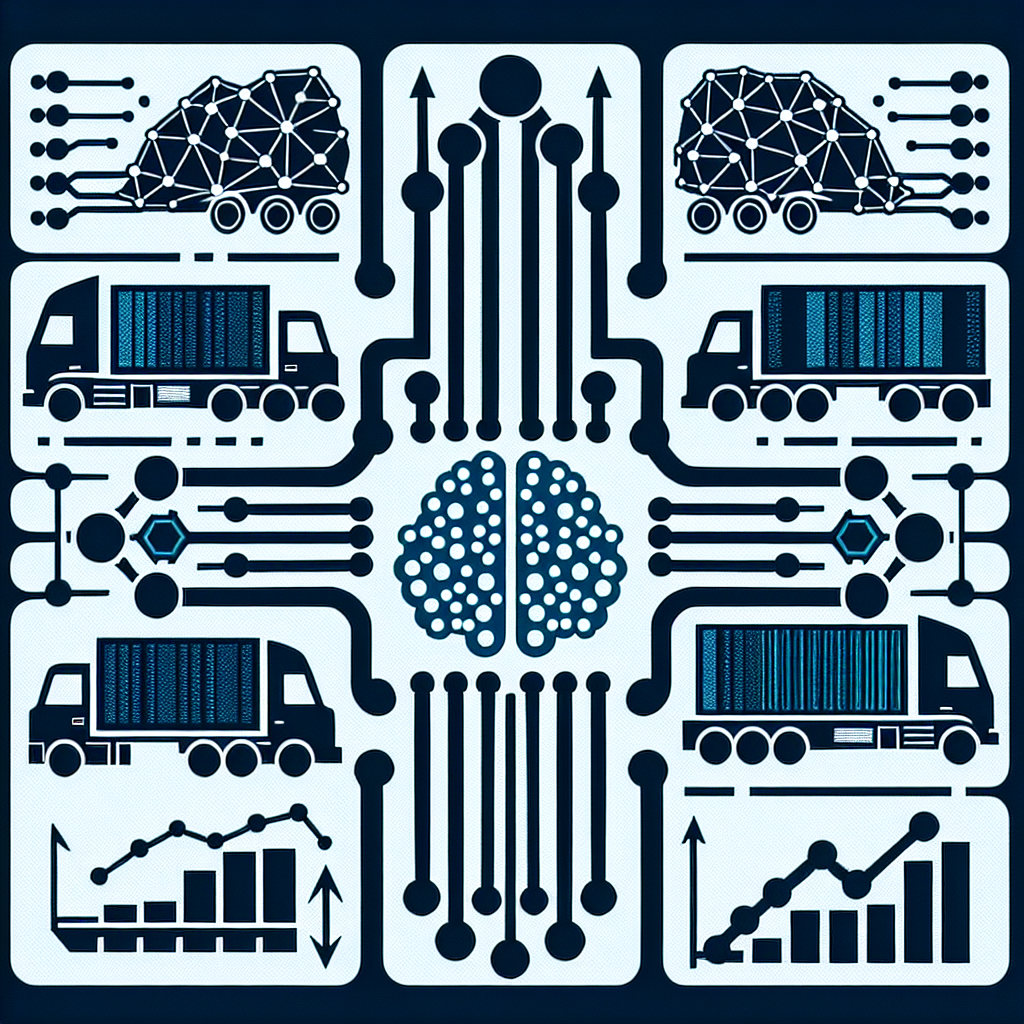
In today’s fast-paced world, businesses are constantly looking for ways to improve their operations and stay ahead of the competition. One area where this is particularly important is in logistics, where the ability to accurately forecast demand can make a big difference in terms of efficiency and cost savings. Traditionally, demand forecasting in logistics has been done using statistical methods and historical data. However, with the advent of machine learning, there is now an opportunity to take this to the next level.
Machine learning is a branch of artificial intelligence that involves the use of algorithms to learn from data and make predictions or decisions. In the context of demand forecasting in logistics, machine learning can be used to analyze historical data and other relevant factors to predict future demand with a high degree of accuracy. This can help companies optimize their inventory levels, plan transportation routes more efficiently, and ultimately improve customer service.
There are several ways in which machine learning can be leveraged for demand forecasting in logistics. One common approach is to use supervised learning algorithms, such as linear regression or neural networks, to analyze historical sales data and other relevant variables (such as seasonality, promotions, and economic indicators) to predict future demand. These models can be trained on past data and then used to make forecasts for future time periods.
Another approach is to use unsupervised learning algorithms, such as clustering or association rules, to identify patterns and relationships in the data that can help to improve demand forecasting. For example, clustering algorithms can be used to group similar products or customers together, which can help to identify trends and patterns that may not be apparent from a simple analysis of historical data.
In addition to these traditional machine learning techniques, there are also more advanced methods that can be used for demand forecasting in logistics. For example, deep learning algorithms, which are a type of neural network with multiple layers, can be used to analyze large and complex datasets to make more accurate predictions. Reinforcement learning, which involves training algorithms to make decisions based on feedback from the environment, can also be used to optimize inventory levels and transportation routes in real-time.
Overall, leveraging machine learning for demand forecasting in logistics can help companies to improve their operations in a number of ways. By making more accurate predictions of future demand, companies can reduce inventory costs, minimize stockouts, and improve customer satisfaction. Machine learning can also help to optimize transportation routes, reduce lead times, and improve overall efficiency in the supply chain.
However, while there are many benefits to using machine learning for demand forecasting in logistics, there are also some challenges and limitations to consider. For example, machine learning models require large amounts of data to train effectively, which can be a challenge for companies with limited historical data or data quality issues. In addition, machine learning models can be complex and difficult to interpret, which can make it challenging for companies to understand and trust the forecasts that are generated.
Despite these challenges, there are a number of best practices that companies can follow to successfully leverage machine learning for demand forecasting in logistics. For example, companies should invest in high-quality data collection and cleaning processes to ensure that the data used to train the models is accurate and reliable. Companies should also work closely with data scientists and domain experts to develop and validate the machine learning models, and to ensure that the forecasts are aligned with the company’s business goals.
In conclusion, leveraging machine learning for demand forecasting in logistics can provide companies with a powerful tool to improve their operations and stay ahead of the competition. By using advanced algorithms to analyze historical data and make accurate predictions of future demand, companies can optimize their inventory levels, plan transportation routes more efficiently, and ultimately improve customer service. While there are challenges and limitations to consider, companies that follow best practices and work closely with data scientists and domain experts can successfully harness the power of machine learning for demand forecasting in logistics.
FAQs:
Q: What are some common machine learning algorithms used for demand forecasting in logistics?
A: Some common machine learning algorithms used for demand forecasting in logistics include linear regression, neural networks, clustering, association rules, deep learning, and reinforcement learning.
Q: How can companies ensure that the data used to train machine learning models is accurate and reliable?
A: Companies can ensure that the data used to train machine learning models is accurate and reliable by investing in high-quality data collection and cleaning processes, working closely with data scientists and domain experts, and validating the models against historical data.
Q: What are some best practices for leveraging machine learning for demand forecasting in logistics?
A: Some best practices for leveraging machine learning for demand forecasting in logistics include investing in high-quality data collection and cleaning processes, working closely with data scientists and domain experts, and aligning the forecasts with the company’s business goals.