
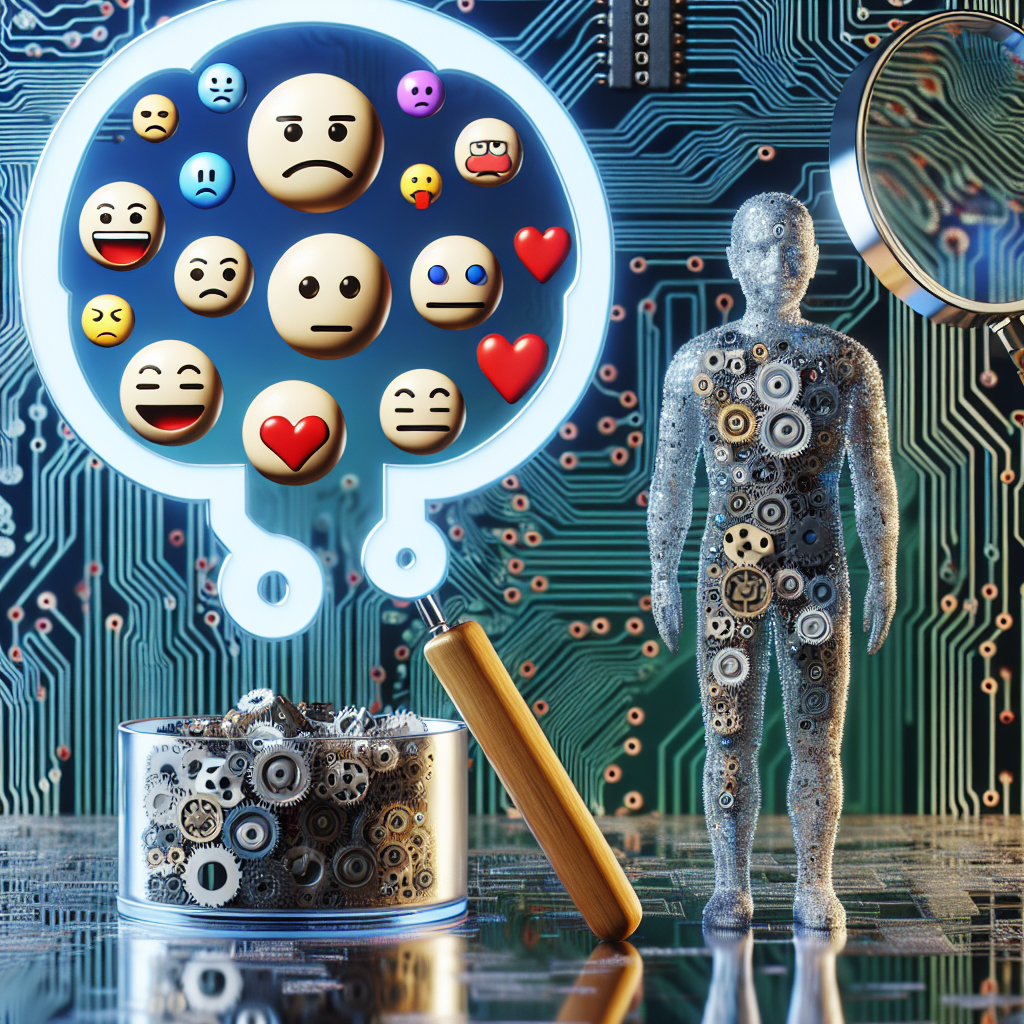
Natural Language Processing (NLP) is a subfield of artificial intelligence that focuses on the interaction between computers and humans using natural language. One of the key challenges in NLP is emotion recognition, which involves analyzing text to identify emotions such as happiness, sadness, anger, and fear. Emotion recognition has numerous practical applications, including sentiment analysis, customer feedback analysis, and mental health monitoring. However, there are several challenges in achieving accurate emotion recognition using NLP techniques.
One of the main challenges in emotion recognition is the ambiguity of language. Natural language is complex and often open to interpretation, making it difficult for machines to accurately identify emotions. For example, a sentence like “I love my job” could express happiness or sarcasm depending on the context. This ambiguity makes it challenging for NLP algorithms to accurately classify emotions.
Another challenge in emotion recognition is the cultural and contextual differences in language. Emotions can be expressed differently across cultures, and language can be highly context-dependent. For example, the word “cool” can mean different things in different contexts – it could refer to something that is trendy or to someone who is calm and collected. NLP algorithms must be trained on diverse datasets to account for these cultural and contextual variations.
Furthermore, emotions are often nuanced and subtle, making them difficult to detect using traditional NLP techniques. Emotions can be expressed through subtle cues such as tone of voice, facial expressions, and body language, which are not captured in text. NLP algorithms must be able to infer emotions from these non-verbal cues to achieve accurate emotion recognition.
Limited labeled data is another challenge in emotion recognition. Supervised learning techniques rely on labeled data to train the model, but emotion-labeled datasets are often small and imbalanced. This limited data can lead to overfitting and poor generalization of NLP models, resulting in inaccurate emotion recognition.
In addition, the lack of standardized benchmarks and evaluation metrics in emotion recognition poses a challenge for researchers and practitioners. Without standardized benchmarks, it is difficult to compare the performance of different NLP models and techniques. This lack of consistency hinders progress in the field of emotion recognition and makes it challenging to develop robust and reliable emotion recognition systems.
Despite these challenges, researchers are making significant strides in emotion recognition using NLP techniques. Recent advancements in deep learning, neural networks, and transfer learning have shown promising results in emotion recognition tasks. By leveraging large-scale datasets, pre-trained models, and advanced algorithms, researchers are able to achieve higher accuracy in emotion recognition.
FAQs:
Q: What is emotion recognition?
A: Emotion recognition is the process of identifying and classifying emotions expressed in text, speech, or other forms of communication. It involves analyzing linguistic cues, tone of voice, facial expressions, and body language to infer emotions such as happiness, sadness, anger, and fear.
Q: What are the applications of emotion recognition?
A: Emotion recognition has numerous practical applications, including sentiment analysis, customer feedback analysis, mental health monitoring, and human-computer interaction. It can be used in marketing to analyze customer sentiments, in healthcare to monitor patients’ emotions, and in chatbots to enhance user experience.
Q: How does emotion recognition work?
A: Emotion recognition typically involves using NLP techniques to analyze text and infer emotions. NLP algorithms process linguistic cues such as words, phrases, and sentence structures to classify emotions. Advanced techniques such as deep learning and neural networks are used to improve the accuracy of emotion recognition.
Q: What are the challenges of emotion recognition in NLP?
A: The challenges of emotion recognition in NLP include the ambiguity of language, cultural and contextual differences, subtle and nuanced emotions, limited labeled data, and lack of standardized benchmarks and evaluation metrics. These challenges make it difficult to achieve accurate emotion recognition using traditional NLP techniques.
Q: How can researchers overcome the challenges of emotion recognition in NLP?
A: Researchers can overcome the challenges of emotion recognition in NLP by leveraging advanced techniques such as deep learning, neural networks, and transfer learning. By using large-scale datasets, pre-trained models, and advanced algorithms, researchers can improve the accuracy and robustness of emotion recognition systems.