
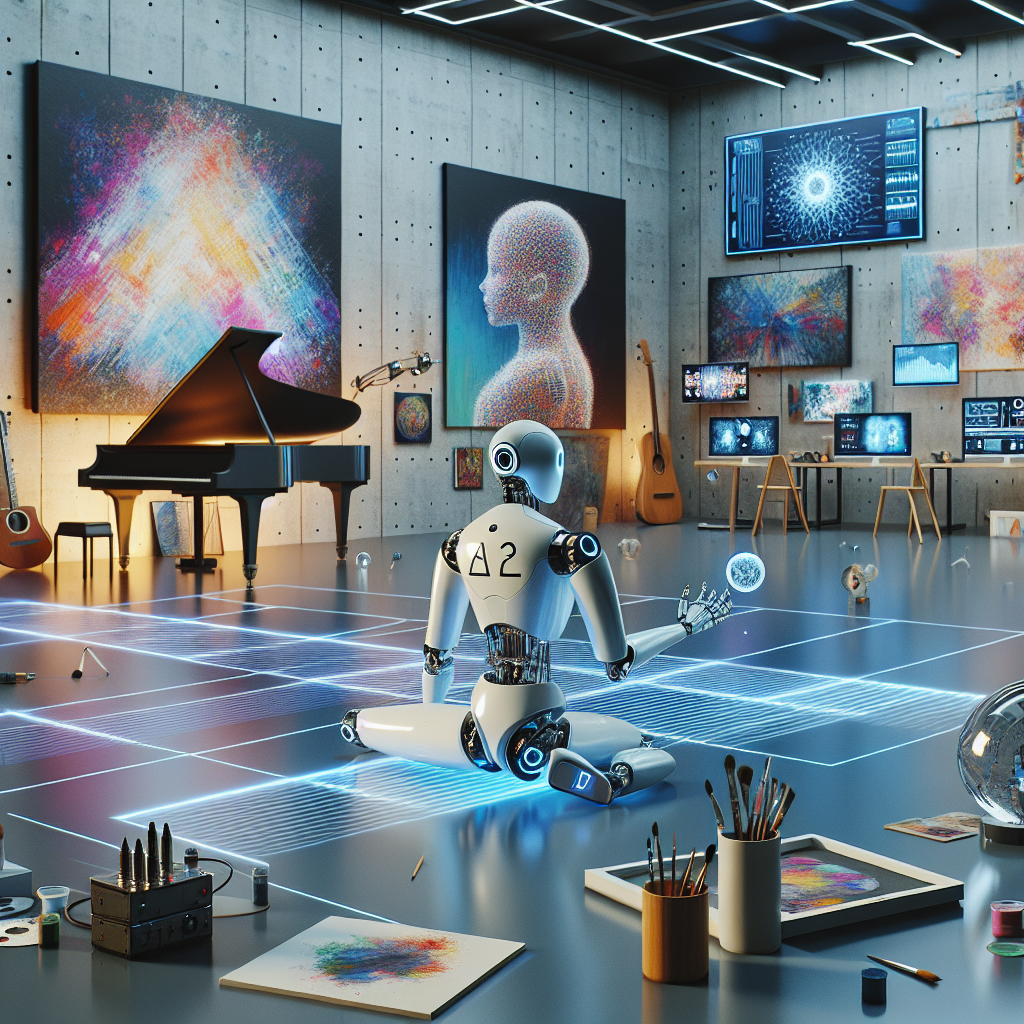
The Future of Creativity: AI’s Role in Shaping the Arts
In recent years, artificial intelligence (AI) has made significant advancements in various fields, including the arts. From creating music and paintings to writing poetry and designing digital content, AI has proven to be a powerful tool for enhancing creativity and pushing the boundaries of artistic expression. As technology continues to evolve, many are left wondering what the future holds for the intersection of AI and the arts.
AI in Music Composition
One of the most notable applications of AI in the arts is in music composition. AI algorithms have been trained to analyze vast amounts of music data and generate original compositions in various styles and genres. These AI-generated pieces have been praised for their complexity and originality, challenging the notion that creativity is exclusive to human beings.
AI in Visual Arts
AI has also been used in the visual arts to create stunning paintings and digital artwork. Artists and designers are using AI algorithms to generate intricate patterns, textures, and shapes that would be difficult or time-consuming to create manually. This has opened up new possibilities for artists to experiment with different styles and techniques, pushing the boundaries of traditional art forms.
AI in Literature
In the world of literature, AI has been used to generate poetry, stories, and even entire novels. By analyzing patterns and structures in existing literature, AI algorithms can generate text that mimics the style and tone of famous authors. While some may argue that AI-generated literature lacks the emotional depth and nuance of human-written works, others see it as a new form of creativity that challenges our preconceived notions of what it means to be an artist.
The Future of Creativity
As AI continues to evolve and become more sophisticated, its role in shaping the arts is only expected to grow. AI has the potential to revolutionize the creative process, offering artists new tools and techniques to explore and experiment with. However, this raises questions about the role of human artists in a world where AI can create art that is indistinguishable from human-made works.
Some believe that AI will never be able to truly replace human creativity, arguing that art is inherently tied to human emotions, experiences, and perspectives. While AI can generate impressive pieces of music, art, and literature, it lacks the ability to truly understand and express the complexity of human emotions. Others see AI as a valuable tool for artists, offering new ways to collaborate, experiment, and push the boundaries of creativity.
FAQs
Q: Can AI truly be creative?
A: While AI can generate impressive works of art, music, and literature, some argue that true creativity is a uniquely human trait that cannot be replicated by machines. AI lacks the ability to feel emotions, make intuitive leaps, and draw on personal experiences, which are essential aspects of the creative process.
Q: Will AI replace human artists?
A: While AI has the potential to revolutionize the creative process, many believe that human artists will always have a place in the arts. AI can generate art that is technically impressive, but it lacks the emotional depth and nuance that human artists bring to their work.
Q: How can artists use AI in their creative process?
A: Artists can use AI as a tool to enhance their creativity and explore new possibilities. AI can help artists generate ideas, experiment with different styles and techniques, and push the boundaries of traditional art forms. By embracing AI, artists can expand their creative horizons and create works that are truly innovative and unique.
In conclusion, the future of creativity is a complex and multifaceted landscape, shaped by the evolving relationship between AI and the arts. While AI has the potential to revolutionize the creative process and offer artists new tools and techniques to explore, it also raises questions about the role of human artists in a world where machines can create art that is indistinguishable from human-made works. As technology continues to advance, it will be interesting to see how artists embrace AI as a tool for creativity and innovation, pushing the boundaries of what is possible in the world of art and design.