
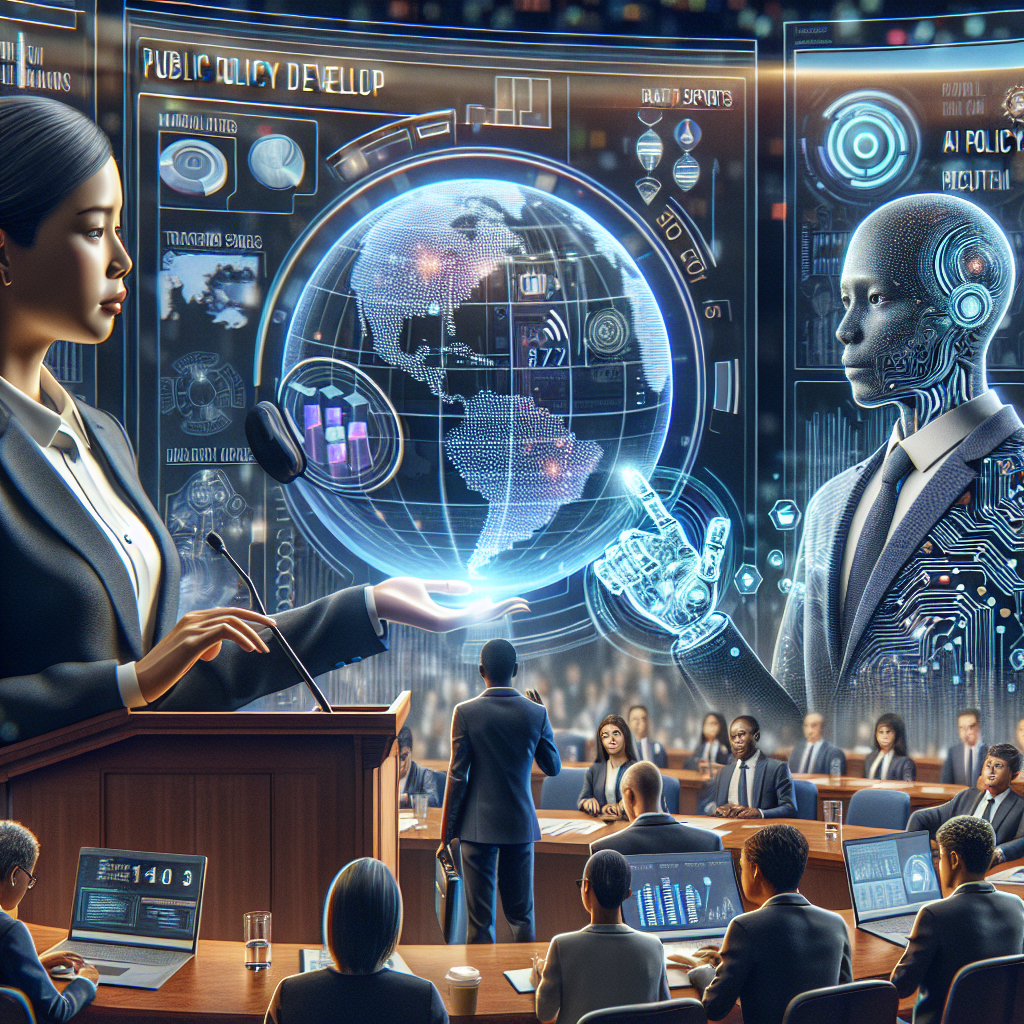
The Role of AI in Public Policy Development
Artificial intelligence (AI) is a rapidly evolving technology that has the potential to revolutionize many aspects of society, including public policy development. AI refers to the simulation of human intelligence processes by machines, such as learning, reasoning, and problem-solving. In recent years, AI has been increasingly used in various sectors, from healthcare to finance, and its applications in the field of public policy are becoming more prevalent.
AI has the ability to process and analyze vast amounts of data in a fraction of the time it would take a human to do so. This capability makes AI an invaluable tool for policymakers, who often need to sift through large volumes of information to make informed decisions. By leveraging AI, policymakers can better understand complex issues, predict outcomes, and develop more effective policies.
One of the key benefits of using AI in public policy development is its ability to identify patterns and trends in data that may not be immediately apparent to human analysts. This can help policymakers uncover correlations between different variables, anticipate potential problems, and design policies that are tailored to specific needs. For example, AI can be used to analyze demographic data to identify communities that are most in need of specific services or resources.
AI can also be employed to model the potential impact of different policy interventions, allowing policymakers to assess the likely outcomes of their decisions before they are implemented. This can help to mitigate risks and ensure that policies are effective in achieving their intended goals. By using AI to simulate different scenarios, policymakers can also test the robustness of their policies and make adjustments as needed.
Furthermore, AI can help to streamline the policymaking process by automating repetitive tasks and freeing up human resources for more complex and creative work. For example, AI can be used to analyze public feedback on proposed policies, identify common themes, and generate summaries for policymakers to review. This can help to expedite the decision-making process and ensure that policies are informed by a wide range of perspectives.
Despite its many benefits, the use of AI in public policy development also raises important ethical and social considerations. For example, there are concerns about bias in AI algorithms, which may inadvertently perpetuate existing inequalities or discriminate against certain groups. Policymakers must be vigilant in ensuring that AI technologies are deployed in a fair and transparent manner, with safeguards in place to prevent unintended consequences.
Another challenge is the potential displacement of human workers by AI systems, as automation becomes increasingly prevalent in policy analysis and decision-making. Policymakers must consider the societal implications of AI adoption and take steps to retrain and reskill workers who may be affected by technological advancements. Additionally, policymakers must be mindful of the privacy implications of using AI to collect and analyze data, ensuring that individuals’ rights are protected.
In conclusion, AI has the potential to transform public policy development by improving data analysis, predicting outcomes, and streamlining decision-making processes. However, its adoption must be approached with caution, taking into account the ethical, social, and economic implications of using AI in policymaking. By leveraging the power of AI responsibly, policymakers can harness its capabilities to develop more effective and equitable policies that benefit society as a whole.
FAQs
Q: How can AI be used to improve public policy development?
A: AI can be used to analyze data, predict outcomes, model policy impacts, automate repetitive tasks, and streamline decision-making processes in public policy development.
Q: What are some of the ethical considerations of using AI in policymaking?
A: Ethical considerations of using AI in policymaking include concerns about bias in algorithms, displacement of human workers, and privacy implications of data collection and analysis.
Q: How can policymakers ensure that AI technologies are deployed in a fair and transparent manner?
A: Policymakers can ensure that AI technologies are deployed in a fair and transparent manner by implementing safeguards to prevent bias, monitoring the impact of AI systems, and engaging with stakeholders to gather feedback.
Q: What steps can policymakers take to address the societal implications of AI adoption?
A: Policymakers can take steps to address the societal implications of AI adoption by retraining and reskilling workers, ensuring that policies are equitable, and protecting individuals’ rights to privacy and data security.