
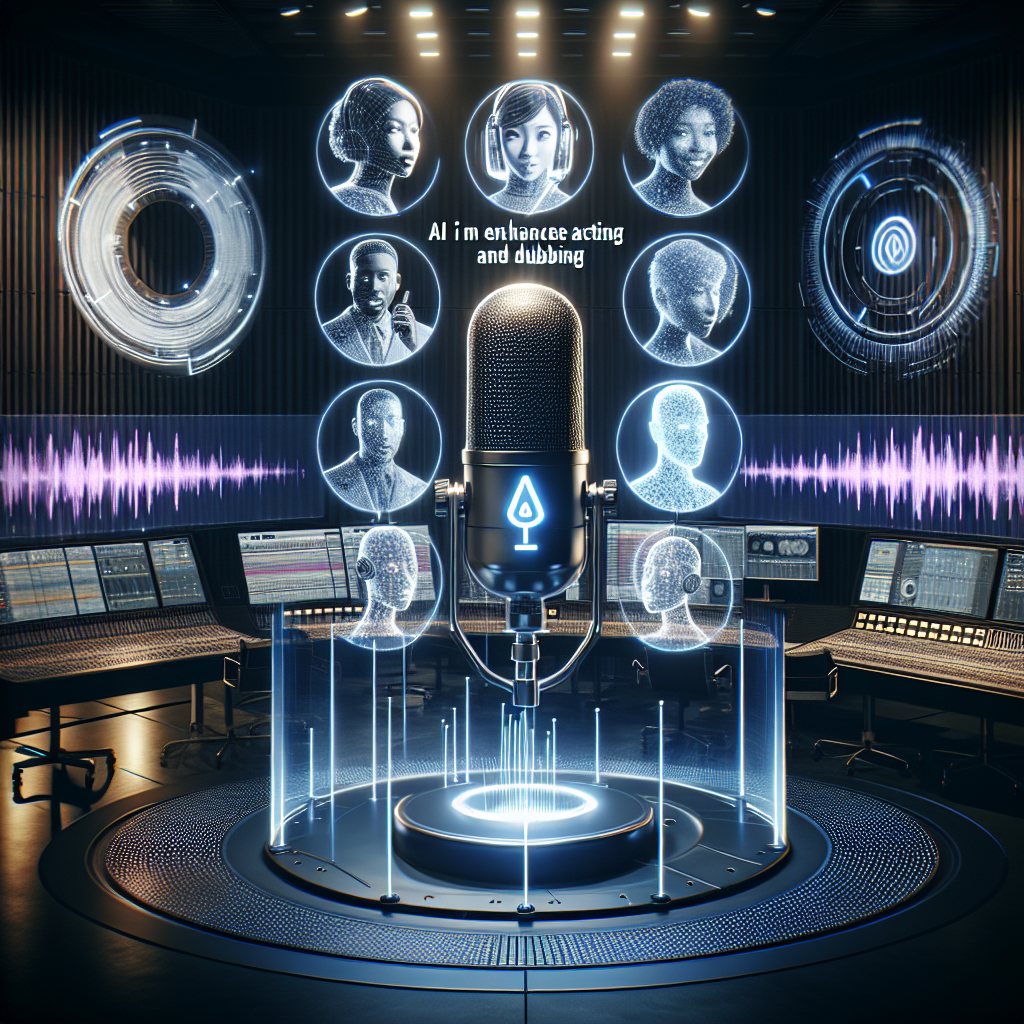
The entertainment industry has always been at the forefront of technological innovation, constantly pushing the boundaries of what is possible in terms of storytelling and production value. One area that has seen significant advancements in recent years is the use of artificial intelligence (AI) in improving voice acting and dubbing in entertainment.
AI technology has the potential to revolutionize the way voice acting and dubbing are done, making the process faster, more efficient, and ultimately more believable. From creating realistic synthetic voices to enabling real-time dubbing in multiple languages, the possibilities are endless.
In this article, we will explore the future of AI in improving voice acting and dubbing in entertainment, looking at the current state of the technology, its potential applications, and the challenges that lie ahead.
Current State of AI in Voice Acting and Dubbing
AI technology has already made significant strides in the field of voice acting and dubbing. One of the most notable advancements is the development of synthetic voices that are indistinguishable from human voices. Companies like Google and Amazon have been working on creating realistic synthetic voices that can be used for a variety of applications, from virtual assistants to audiobooks.
These synthetic voices are created using deep learning algorithms that analyze large amounts of speech data to understand the nuances of human speech. By training these algorithms on a diverse range of voices and accents, developers are able to create synthetic voices that sound natural and expressive.
Another area where AI is making a big impact is in real-time dubbing. Traditionally, dubbing involves recording a new voiceover track in a different language and then syncing it with the original audio. This process can be time-consuming and expensive, especially for productions that need to be dubbed in multiple languages.
AI technology is changing the game by enabling real-time dubbing using machine translation and speech synthesis algorithms. These algorithms can translate the original dialogue into a different language and then generate a synthetic voiceover in real-time, allowing for seamless dubbing without the need for human actors.
Potential Applications of AI in Voice Acting and Dubbing
The potential applications of AI in voice acting and dubbing are vast and varied. One of the most exciting possibilities is the ability to create custom voices for characters in animated films and video games. By using AI algorithms to generate realistic synthetic voices, developers can create unique and expressive characters that bring stories to life in new and exciting ways.
AI technology can also be used to improve the quality of dubbing in international markets. By enabling real-time dubbing in multiple languages, producers can reach a global audience more easily and cost-effectively. This could open up new opportunities for filmmakers and content creators to expand their reach and connect with audiences around the world.
Furthermore, AI can help streamline the voice acting process by automating tasks such as script analysis, voice modulation, and lip synchronization. This can save time and resources for production companies, allowing them to focus on creating high-quality content without being bogged down by tedious manual tasks.
Challenges and Considerations
While the future of AI in voice acting and dubbing is promising, there are still some challenges and considerations that need to be taken into account. One of the biggest challenges is ensuring that synthetic voices sound natural and expressive. While AI algorithms have made great strides in this area, there is still room for improvement in terms of capturing the nuances of human speech.
Another consideration is the ethical implications of using AI technology in voice acting. As synthetic voices become more advanced, there is a risk that they could be used to create deepfake audio recordings that could be used for malicious purposes. It will be important for developers to implement safeguards to prevent misuse of this technology.
Finally, there is the issue of job displacement. As AI technology becomes more prevalent in voice acting and dubbing, there is a concern that human actors could be replaced by synthetic voices. While AI can certainly streamline the production process and make it more efficient, it is important to strike a balance between automation and human creativity in order to preserve the artistry of voice acting.
FAQs
Q: Can AI technology replace human voice actors?
A: While AI technology has made great advancements in creating synthetic voices, it is unlikely that human voice actors will be completely replaced. Human actors bring a level of emotion, expression, and nuance to their performances that is difficult to replicate with AI. However, AI can be used to enhance and streamline the voice acting process, making it more efficient and cost-effective.
Q: How can AI technology improve the quality of dubbing in entertainment?
A: AI technology can improve the quality of dubbing by enabling real-time dubbing in multiple languages, creating custom voices for characters, and automating tasks such as script analysis and voice modulation. This can help producers reach a global audience more easily and cost-effectively, while also saving time and resources in the production process.
Q: What are the ethical considerations of using AI in voice acting and dubbing?
A: One of the main ethical considerations of using AI in voice acting and dubbing is the potential for misuse of synthetic voices to create deepfake audio recordings. Developers will need to implement safeguards to prevent this type of misuse and ensure that AI technology is used responsibly. Additionally, there is a concern about job displacement for human voice actors, which will need to be addressed as AI technology becomes more prevalent in the industry.