
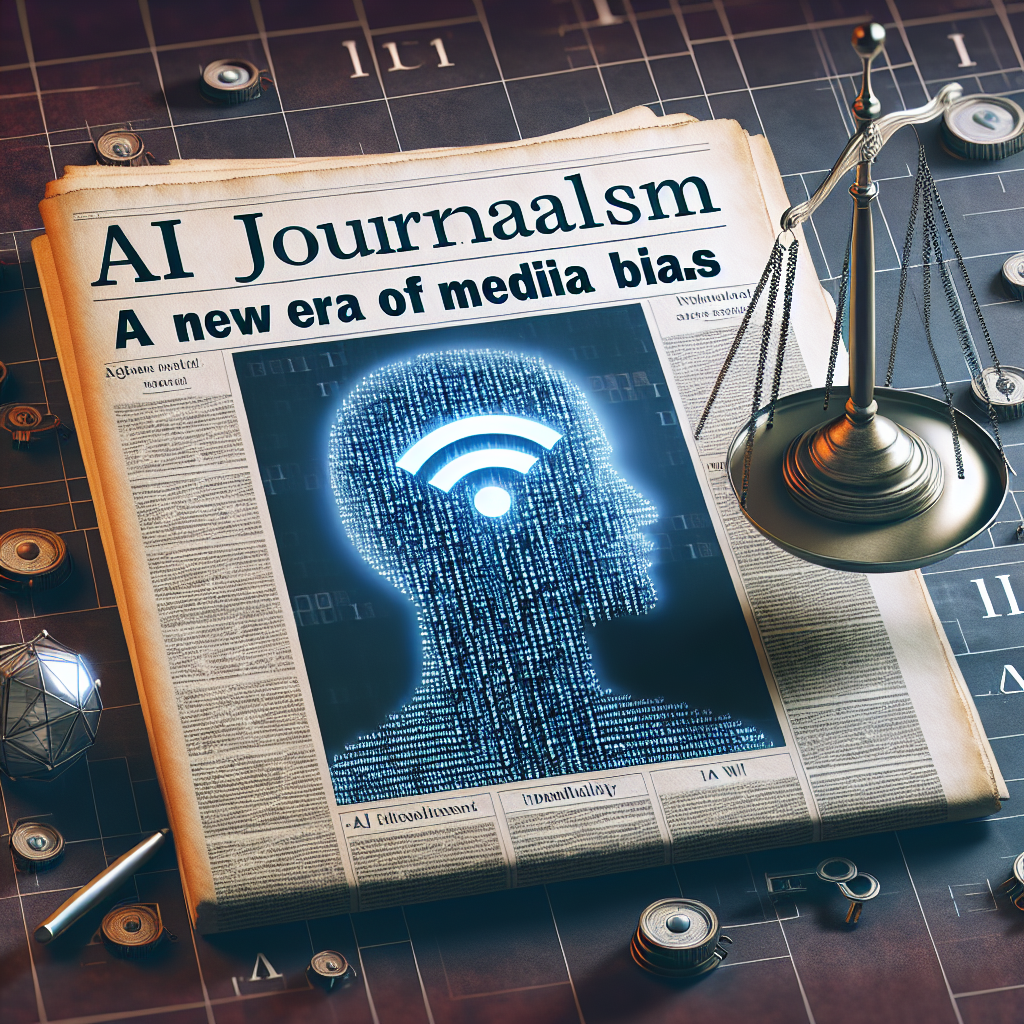
AI Journalism: A New Era of Media Bias?
In recent years, the rise of artificial intelligence (AI) has revolutionized many industries, including journalism. AI technologies have been used to automate news writing, personalize content for readers, and even detect fake news. While AI journalism has the potential to enhance the efficiency and accuracy of news reporting, it has also raised concerns about the potential for bias in news coverage. In this article, we will explore the impact of AI on journalism and discuss whether it is leading to a new era of media bias.
AI Journalism: The Basics
AI journalism refers to the use of artificial intelligence technologies to automate various aspects of the news reporting process. This includes tasks such as data analysis, fact-checking, content creation, and even distribution. AI algorithms can analyze large volumes of data in a fraction of the time it would take a human reporter, allowing news organizations to produce stories more quickly and efficiently.
One of the most common applications of AI journalism is the use of natural language processing (NLP) algorithms to generate news stories automatically. These algorithms can scan data sources, extract key information, and write up a news article in minutes. Automated news writing has been used by news organizations to cover events such as sports games, financial reports, and weather updates.
Another key aspect of AI journalism is personalization. AI algorithms can analyze a reader’s browsing history, social media activity, and other data points to tailor news content to their interests and preferences. This personalized approach can help news organizations attract and retain readers in an increasingly competitive media landscape.
AI Journalism and Media Bias
While AI journalism offers many benefits, it also raises concerns about the potential for bias in news coverage. One of the main issues is that AI algorithms are only as good as the data they are trained on. If the training data is biased or incomplete, the algorithm may produce biased or inaccurate news stories.
For example, if an AI algorithm is trained on a dataset that contains predominantly negative stories about a particular group or community, it may inadvertently produce biased coverage that reinforces negative stereotypes. This can lead to a lack of diversity in news coverage and perpetuate harmful narratives.
Another concern is the lack of transparency in AI algorithms. News organizations that use AI journalism may not always disclose how their algorithms work or what data sources they are using. This lack of transparency can make it difficult for readers to assess the reliability and credibility of AI-generated news stories.
Furthermore, the personalization of news content by AI algorithms can create filter bubbles, where readers are only exposed to information that aligns with their pre-existing beliefs and opinions. This can lead to echo chambers where individuals are not exposed to diverse viewpoints and may become more polarized in their thinking.
Overall, the rise of AI journalism has the potential to exacerbate existing issues of media bias and misinformation in the news industry. While AI technologies can enhance the efficiency and accuracy of news reporting, they also pose risks for creating biased or inaccurate news coverage.
FAQs
Q: How can news organizations ensure that AI journalism is not biased?
A: News organizations can take several steps to mitigate bias in AI journalism, including diversifying their training data, regularly auditing their algorithms for bias, and being transparent about their use of AI technologies.
Q: Can AI algorithms be programmed to detect and correct bias in news coverage?
A: Yes, AI algorithms can be trained to detect bias in news coverage by analyzing language patterns, sentiment analysis, and other data points. However, it is challenging to completely eliminate bias from AI journalism.
Q: What role do journalists play in ensuring unbiased news coverage in the era of AI journalism?
A: Journalists play a crucial role in fact-checking AI-generated stories, providing context and analysis, and holding news organizations accountable for bias in their reporting. Journalists should also advocate for transparency and ethical use of AI technologies in journalism.
Q: How can readers identify biased news coverage in the era of AI journalism?
A: Readers can be critical consumers of news by seeking out diverse sources of information, fact-checking stories, and being aware of their own biases and filters. It is important for readers to be vigilant in questioning the accuracy and credibility of news stories, especially those generated by AI algorithms.
In conclusion, AI journalism has the potential to transform the news industry by enhancing efficiency and personalization. However, it also raises concerns about the potential for bias in news coverage. News organizations, journalists, and readers must work together to ensure that AI journalism is used responsibly and ethically to provide accurate, diverse, and unbiased news coverage in the digital age.