
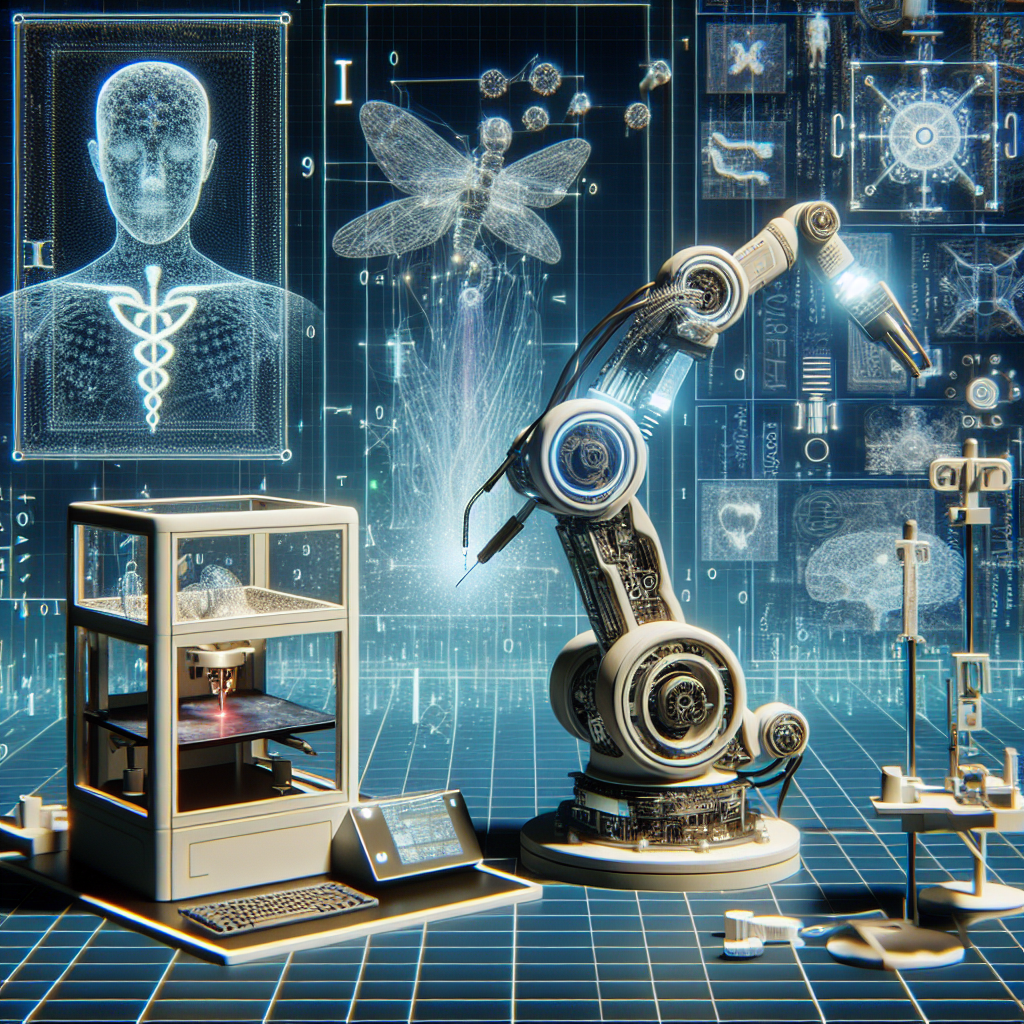
Artificial Intelligence (AI) and 3D printing are revolutionizing the healthcare industry in unprecedented ways. These technologies are helping to improve patient care, streamline processes, and advance medical research and development. In this article, we will explore how AI and 3D printing are being used in healthcare, the benefits they bring, and the potential challenges that come with their adoption.
AI in Healthcare:
Artificial intelligence has the potential to transform healthcare by enabling faster and more accurate diagnosis, personalized treatment plans, and improved patient outcomes. AI algorithms can analyze vast amounts of medical data, including patient records, images, and genetic information, to identify patterns and make predictions that can help healthcare providers make informed decisions.
One of the key applications of AI in healthcare is in medical imaging. AI-powered algorithms can analyze medical images such as X-rays, MRIs, and CT scans to detect abnormalities and assist radiologists in making accurate diagnoses. This can help to improve the efficiency and accuracy of diagnosis, leading to earlier detection of diseases and better outcomes for patients.
AI is also being used to develop personalized treatment plans for patients. By analyzing a patient’s medical history, genetic information, and other relevant data, AI algorithms can recommend the most effective treatment options based on the individual’s unique characteristics. This can help to tailor treatment plans to the specific needs of each patient, leading to better outcomes and reduced side effects.
Another important application of AI in healthcare is in drug discovery and development. AI algorithms can analyze vast amounts of data to identify potential drug candidates, predict their efficacy, and optimize their design. This can help to accelerate the drug development process, reduce costs, and bring new treatments to market more quickly.
Overall, AI has the potential to revolutionize healthcare by enabling more personalized, efficient, and effective care for patients. However, the adoption of AI in healthcare also raises important ethical and regulatory challenges, such as ensuring patient privacy and data security, addressing biases in AI algorithms, and maintaining transparency and accountability in decision-making.
3D Printing in Healthcare:
3D printing, also known as additive manufacturing, is another technology that is transforming healthcare by enabling the creation of customized medical devices, implants, and tissues. 3D printing allows for the rapid and cost-effective production of complex, patient-specific objects that can improve patient care and outcomes.
One of the key applications of 3D printing in healthcare is in the production of medical devices and implants. 3D printing technology allows for the creation of customized implants that are tailored to the specific anatomy of individual patients. This can help to improve the fit and function of implants, reduce the risk of complications, and improve patient comfort and quality of life.
In addition to medical devices and implants, 3D printing is also being used to create tissues and organs for transplantation. Researchers are exploring the use of 3D printing technology to create complex tissues and organs, such as hearts, kidneys, and livers, that can be used to replace damaged or diseased organs in patients. While this technology is still in the early stages of development, it has the potential to revolutionize organ transplantation and address the shortage of donor organs.
Furthermore, 3D printing is being used in the production of prosthetics and orthotics. 3D printing technology allows for the rapid and cost-effective production of customized prosthetic limbs, orthotic devices, and other assistive devices that can improve mobility and quality of life for patients with disabilities.
Overall, 3D printing has the potential to revolutionize healthcare by enabling the production of customized medical devices, implants, and tissues that can improve patient care and outcomes. However, the adoption of 3D printing in healthcare also raises important ethical and regulatory challenges, such as ensuring the safety and quality of 3D-printed medical devices, addressing intellectual property issues, and ensuring the ethical use of 3D printing technology in healthcare.
AI and 3D Printing in Healthcare: The Future of Medicine
The convergence of AI and 3D printing in healthcare holds immense promise for the future of medicine. By combining the power of AI to analyze vast amounts of medical data and make predictions with the ability of 3D printing to create customized medical devices, implants, and tissues, healthcare providers can deliver more personalized, efficient, and effective care for patients.
One of the key areas where AI and 3D printing are expected to have a significant impact is in personalized medicine. By leveraging AI algorithms to analyze patient data and 3D printing technology to create customized medical devices and treatments, healthcare providers can tailor care to the specific needs of each patient, leading to better outcomes and improved patient satisfaction.
Another important application of AI and 3D printing in healthcare is in medical education and training. By using AI-powered simulations and 3D-printed models, medical students and healthcare professionals can practice complex procedures, such as surgeries, in a safe and controlled environment. This can help to improve the skills and confidence of healthcare providers, leading to better patient care and outcomes.
Furthermore, AI and 3D printing are expected to play a key role in advancing medical research and development. By using AI algorithms to analyze medical data and identify patterns, researchers can gain new insights into disease mechanisms, drug interactions, and treatment options. 3D printing technology can then be used to create customized models and prototypes for testing new drugs, treatments, and medical devices.
Overall, the integration of AI and 3D printing in healthcare has the potential to revolutionize medicine by enabling more personalized, efficient, and effective care for patients. However, the adoption of these technologies also raises important ethical, regulatory, and societal challenges that must be addressed to ensure their responsible and ethical use in healthcare.
FAQs:
Q: How is AI being used in medical imaging?
A: AI algorithms are being used in medical imaging to analyze X-rays, MRIs, CT scans, and other medical images to detect abnormalities and assist radiologists in making accurate diagnoses. This can help to improve the efficiency and accuracy of diagnosis, leading to earlier detection of diseases and better outcomes for patients.
Q: What are some of the key applications of 3D printing in healthcare?
A: Some of the key applications of 3D printing in healthcare include the production of customized medical devices and implants, the creation of tissues and organs for transplantation, and the production of prosthetics and orthotics. 3D printing technology allows for the rapid and cost-effective production of complex, patient-specific objects that can improve patient care and outcomes.
Q: What are some of the challenges of adopting AI and 3D printing in healthcare?
A: Some of the challenges of adopting AI and 3D printing in healthcare include ensuring patient privacy and data security, addressing biases in AI algorithms, maintaining transparency and accountability in decision-making, ensuring the safety and quality of 3D-printed medical devices, addressing intellectual property issues, and ensuring the ethical use of these technologies in healthcare.
In conclusion, AI and 3D printing are transforming the healthcare industry by enabling more personalized, efficient, and effective care for patients. These technologies have the potential to revolutionize medicine by improving diagnosis, treatment, and research, but they also raise important ethical, regulatory, and societal challenges that must be addressed. By harnessing the power of AI and 3D printing responsibly and ethically, healthcare providers can unlock the full potential of these technologies to improve patient care and outcomes.