
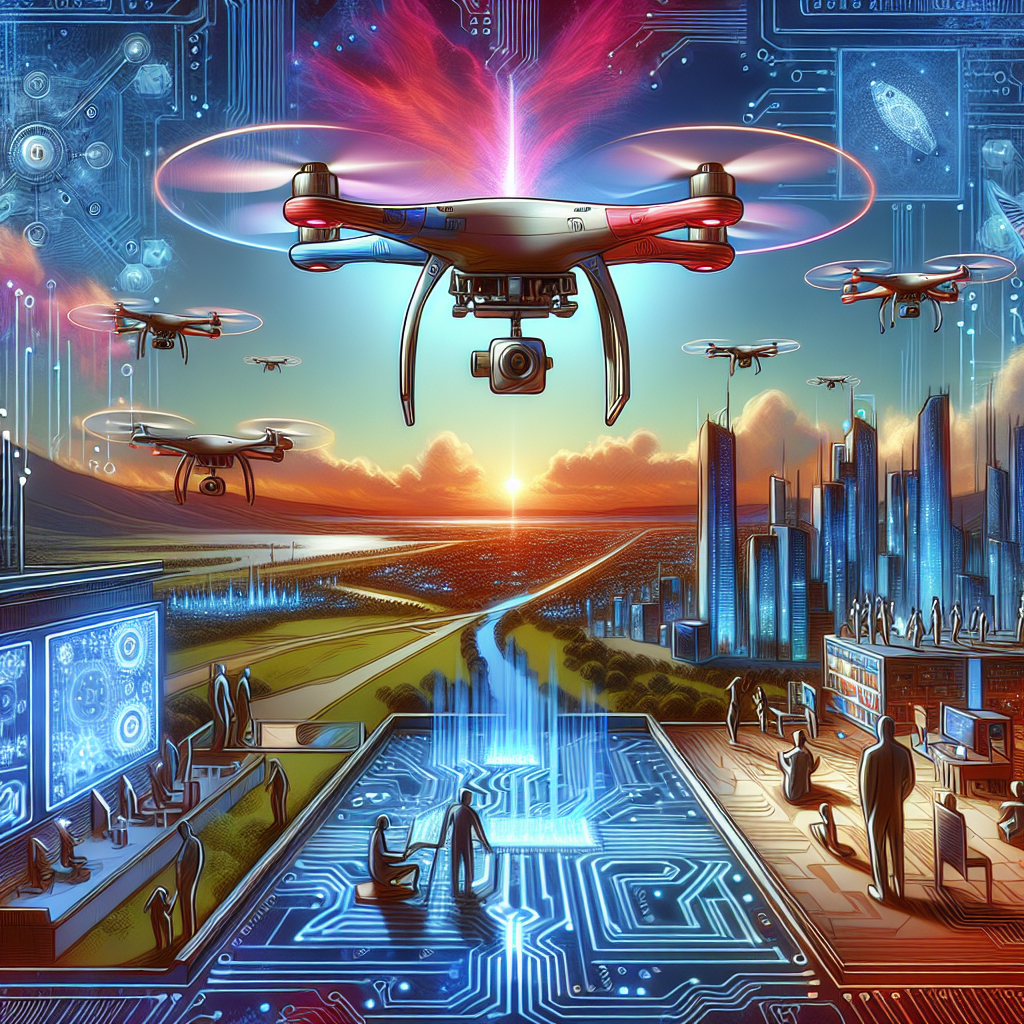
Autonomous drones have become an increasingly popular technology in recent years, with applications ranging from aerial photography and surveillance to package delivery and search and rescue missions. One of the key drivers behind the advancement of autonomous drones is the development of artificial intelligence (AI) technology. AI enables drones to make decisions and navigate their surroundings without human intervention, making them more efficient and versatile.
AI development for autonomous drones involves a combination of machine learning, computer vision, and sensor technology. Machine learning algorithms enable drones to analyze and interpret data from their surroundings, allowing them to make decisions based on their observations. Computer vision technology enables drones to “see” their surroundings and identify objects and obstacles in real-time. Sensor technology, such as GPS and inertial sensors, provides drones with information about their position and orientation, enabling them to navigate accurately.
One of the key challenges in AI development for autonomous drones is training the algorithms to make accurate decisions in a variety of scenarios. Drones must be able to navigate complex environments, avoid obstacles, and make decisions quickly and efficiently. This requires a large amount of training data and sophisticated algorithms that can learn from this data and adapt to new situations.
Another challenge is ensuring the safety and reliability of autonomous drones. Drones must be able to operate safely in a variety of conditions, including high winds, low visibility, and crowded environments. AI technology must be robust enough to handle these challenges and ensure that drones can operate safely and effectively.
Despite these challenges, AI development for autonomous drones has made significant progress in recent years. Drones are now able to perform a wide range of tasks autonomously, from mapping and surveying to monitoring and surveillance. Companies like DJI, Skydio, and Amazon are investing heavily in AI technology for drones, and the market for autonomous drones is expected to grow rapidly in the coming years.
FAQs:
Q: How does AI technology enable drones to navigate autonomously?
A: AI technology enables drones to analyze data from their surroundings, make decisions based on this data, and navigate accurately using sensor technology like GPS and inertial sensors.
Q: What are some of the key challenges in AI development for autonomous drones?
A: Some of the key challenges include training algorithms to make accurate decisions in a variety of scenarios, ensuring the safety and reliability of autonomous drones, and developing algorithms that can adapt to new situations.
Q: What are some of the applications of autonomous drones?
A: Autonomous drones have a wide range of applications, including aerial photography, surveillance, package delivery, search and rescue missions, and monitoring and mapping.
Q: Which companies are leading the way in AI development for autonomous drones?
A: Companies like DJI, Skydio, and Amazon are investing heavily in AI technology for drones and are leading the way in the development of autonomous drone technology.
In conclusion, AI development for autonomous drones is a rapidly growing field with a wide range of applications and challenges. As AI technology continues to advance, we can expect to see drones become even more versatile and efficient in the future. Companies and researchers are working on overcoming the challenges of training algorithms, ensuring safety and reliability, and adapting to new situations. With continued investment and innovation, the future of autonomous drones looks bright.